Thursday, September 21, 2006

What I forgot to say at the conference

As you can see from the picture, I am moving too fast! The main theme of my brief talk was that the ability to study (and therefore to understand better) the brain has moved stuttering research in new territory. This is also the main theme of my blog. What I forgot to do is to explain why.

Ten years ago, you could formulate nearly every type of theory: a left-right conflict in the brain, the amygdala is overactive, the motor coding doesnt work well, and so on. Actually, my favourite theory is that little demon (probably female) getting drunk on occasionally tripping on the pathways that deliver the go-speak signal to the motor cortex. It is very different nowadays: If you support a theory, you need to explain all the new experimental evidence, for example:
  1. Can your theory explain the genetic component?
  2. If your theory focuses on a specific brain region, why doesnt it show up in brain imaging scans?
  3. Why does this drug reduce stuttering?
So finally at last, you cannot just go about and say anything you like. You can still go and write about it, but you can no longer claim that you are doing research or science.

That is the real progress that is being made. It is still some way of, but theory building getting more constructive due to experimental constraints.

Tuesday, September 19, 2006

Zeitgeist of the BSA conference

Here are some general ideas floating around at the conference or in my brain during the conference:

1) over the last decade, more and more experimental findings are starting to constrain any theory building. Ten years ago, you could have said pretty much everything about what is happening inside the brain, but nowadays you need to face up with evidence that needs to fit your theory; a situation that many "researchers" find difficult to handle!!!!

2) there is definitely a genetic component to stuttering, but not a single gene.

3) stuttering is likely to be hetero-causal i.e. different causes lead to stuttering but on the same circuit.

4) genetic tests are going on and we should expect more research news happening. Dryana collected blood samples for his research. He run out of needles, so there was a great willingness to donate blood!

5) having a research session attached to the BSA conference worked well, and was a very cheap way of organising a mini research conference.

6) stuttering research is becoming more and more of a real science.

7) the Pagoclone study has still not published their results fully.

8) the researchers I invited seemed to have genuinely enjoyed the cross-disciplinary debate.

More soon. I have to go to Oxford to pick up my back pack that I forgot on the train. I hope it's mine!!!

Monday, September 18, 2006

Successful BSA conference.

I just came back from the BSA conference in Telford. The research section that I organised went extremely well. Everyone seemed very happy with the talks and the workshop. Dennis Dryana got many volunteers to donate blood for genetics research; he even run out of needles.

I am currently in London, and I am busy trying to get back my back pack that I lost yesterday on the train from Oxford to Reading, if you found it, let me know!! If you stole it, may god bless you with eternal stuttering! :-)

I'll update you on Wednesday evening about the conference talks. The picture of what stuttering is about is getting clearer in my view.

Sunday, September 03, 2006

The new sciences of stuttering

I still have problems. But here is the first part of the description of research program at the Telford conference.

The new sciences of stammering

Over the last decade, advances in brain imaging, genetics, and pharmacology have provoked a revolution in the scientific understanding of the human brain. Scientists are now using this knowledge combined with the new research tools to tackle an age-long mystery: the mechanism and causes of stammering, and how best
to treat stammering. The BSA has invited to its annual conference in Telford leading researchers in the fields of neuroscience, genetics, and pharmacology to share with us the new sciences of stammering and answer the question: How are
neuroscience, pharmacology and genetics changing our understanding and treatment of stammering?

The main session of the program is the research plenary where leading researchers give conceptually clear and simple reviews of the progress made in their research area. After a tea break, the audience has the opportunity to ask probing questions to the panel or comment on any issues related to understanding or treating stuttering. The general sessions are followed by a research symposium where the experts will present and discuss cross-disciplinary topics.

For further information, please contact tom.weidig@physics.org
or visit the BSA website: www.stammering.org/conf.html.

Details of The New Sciences of Stuttering

Plenary
(Chair: Velda Osborne, Sat Sep 16th Sep 9:00-10:30)

Introducing the new sciences of stammering
(Tom Weidig)

The genetics of stuttering: a review
(Dennis Drayna, National Institute of Health, US)

The pharmacology of stuttering: a review
(Gerald Maguire, University of California at Irvine, US)

The brain and stuttering: a review
(Per Alm, University of Oxford)

Q&A sessions
(Chair: Tom Weidig, Sat Sep 16th 11:00-12:00)

Panel consists of speakers plus Kate Watkins, and LouiseWright.


Symposium
(Chair: Tom Weidig, Sat Sep 16th 14:00-17:30)

Given a gene, what is its function? Given a function, what is its gene? What if gene combinations make up a function? (Dennis Drayna)

Similarities and differences in the functional brain abnormalities associated with developmental stuttering and with a mutation in the FOXP2 gene. (Kate Watkins)

What does a medication-induced reduction in stuttering tell us about physiology and genetics of stuttering? (Gerald Maguire)

Is the dopamine D2 receptor important for genetic childhood stuttering? Neurological incidents and subgrouping. (Per Alm)

The measurement problem in stammering: a cross-disciplinary Pandora's box. (additional workshop on Sunday morning)

Main speakers of plenary


Dr. Gerald Maguire is Associate Professor at the Department of Psychiatry at the University of California, Irvine. He is a member of the US national stuttering association (NSA) and currently serves on its research advisory board. As a person who stutters himself, he has been interested in investigating novel treatments for stuttering since early in his medical training. His research group was the first to investigate brain differences in stutterers using the PET brain imaging method. He was the lead investigator on many studies investigating medications for the treatment of stuttering. At the Telford BSA conference, he will also talk about the latest trial on Pagoclone. Dr Maguire has spoken at a wide range of conferences like NSA, World Congress of Stuttering and ASHA. His research appeared at news outlets like the LA Times, NPR, ABC News, and the Boston Globe.

Dr. Dennis Drayna is a senior researcher in genetics at the National Institutes of Health in Bethesda, Maryland, where he currently serves as a Section Chief in the National Institute on Deafness and Other Communication Disorders. His primary research interests are the genetics of human communication disorders, work that has taken him to eight different countries on four continents in pursuit of families with these disorders. For example, he collected blood samples from an extended Pakistani family where many of its members stutter. At the Telford BSA conference, Dr. Drayna will discuss his latest research, and also collect blood samples from volunteers for his research work. He did a PhD at Harvard University, worked as a postdoctoral fellowship in the Howard Hughes Medical Institute at the University of Utah, and then spent 14 years in the biotechnology industry in the San Francisco Bay area.

Main Speakers of Plenary

Dr. Per Alm is a researcher at the University of Oxford, and works together with Dr. Kate Watkins on a project to understand the relationship between stuttering and brain functions. As a person who stutters he got involved in work on stuttering through the Swedish Stuttering Association. Having worked as an engineer in his previous life, he decided to take on stuttering, and go back to university to study neurosciences. He recently finished his PhD thesis on the causal mechanisms of stuttering at Lund University, Sweden. His attempts to combine a wide range of findings to a neurological model of stuttering have been well-received. He has especially emphasized the role of the brain structures called the basal ganglia. At the Telford BSA conference, Dr. Alm will discuss how the current understanding of the brain may help us understand stuttering.

Friday, September 01, 2006

The blog works again.

That is typical. I write a comment that the blog doesnt work anymore, and the next second the blog works again!! I swear that it hadnt worked for 4 days at least! :-)

Tuesday, August 22, 2006

New layout and functionality!!

I have upgraded my Blogger Account to the new Beta version. That's why you see a new layout. I will change some things. There is a bit too much empty space on the page, and the width of the post area could be bigger. But then again even if I dont write a lot, it looks like a big post! And, of course, my picture is too small!! Oh vanity.. :-)

But the real cool thing is the old posts. You can browse THROUGH ALL MY PAST POSTS and do not have to rely on my momentary state of the mind for thoughts on stuttering research!

Monday, August 21, 2006

Admin work on stuttering

At the moment, I am doing more admin work rather than thinking about stuttering itself.

I am still preparing the conference at Telford (UK). The morning session is sorted, but not the afternoon session yet. But should prove to be very interesting. The theme will be cross-disciplinary questions. Per will talk about the levels D1/D2 receptors and how they might kick-start stuttering, and how the levels might be directly related to the statistical signals we see in genetics of stuttering.

I plan to do a flyer which I will send to all the people that might interested in the conference. I will also post it here, and I would appreciate any propaganda!

I am also sending my talk to a few people that I met at the IFA conference.

Tuesday, August 15, 2006

BSA Telford Conference

I am currently preparing the research section of the British Stammering Association (BSA) annual conference at Telford from September 15th to 17th. You find more information: here.

This year there will be a big research section on Sat Sep 16th. I have managed to get Denis Drayna from NIH, a leading experts in genetics of stuttering, Gerry Maguire, a leading experts in pharmacology of stuttering (he is the chief investigator for the Pagoclone study, I think, but certainly involved), Per Alm who has done excellent work in brain research and whom I consider one of the best and most rigorous scientists working on stuttering albeit with no permanent position, no research group of its own and not significant money behind, and Kate Watkins who is a lecturer at Oxford University and had done a lot of brain work before, and heads the research project into stuttering and hired Per to be postdoctoral researcher.

There will be a morning session with a research plenary followed by a Q&A session. Per, Gerry and Dennis will each talk about their respective research field and one has been achieved so far. I will give a brief 10-minute presentation to set the stage, but they will talk for 20-30 minutes each. I also chair the Q&A session with the panel being Per, Gerry, Dennis, Kate and Louise Wright, an SLT / researcher / lecturer who has been involved with the BSA for a long time and is probably best know for a multi-dimensional evaluation system called WASP. The research plenary will be attended by all conference participants, so we need to make it as conceptually simple and entertaining as possible.

In the afternoon, I am planning a mini-conference with talks by the researchers and debate with a multi-disciplinary slate... this is work in progress...

If you are interested in research, I hope you can make it to Telford in England!

I will also be completely jet-lagged as I return from a one-week consultancy project from San Diego (California) at 6 o'clock in the morning at London Heathrow.

Thursday, August 10, 2006

Apologies

My apologies for no recent posts.

I am actually quite busy being a consultant, and trying to settle in my new flat.

In the next days, I will talk more about the IFA conference, and I will explain what is going to happen at the BSA conference in September in Telford. There will be a big session on research into stuttering. I invited three leading researcher in the three most exciting new research field of stuttering: Per Alm for brain research, Denis Drayna for genetics, and Jerry Maguire for pharmaceutical research.

Thursday, July 27, 2006

IFA conference Day 1 and 2

I am currently in Dublin attending the IFA conference. Here are some interesting talks I have been to.

Gerald Maguire was talking about drug treatment. He also discussed the Pagoclone results. However, he did not reveal much more than at the press release on the Indevus website: see my earlier posts. He said that the journal that they submitted the results to has an embargo until their own press release. And this has not happened yet. Apparently, it is a journal that both practioners and medical doctors might read. So I guess they are aiming for Nature, Science, or Lancet. I asked him whether they take care of the possibility that a few severe stutterers significant improvements can distort the data. He said that they take very severe and mild stutterer out before the stats. To summarise, we need to wait a bit more for more meat on the study. However, he did reveal a bit more on the open-label extension. 90% of the participants kept on taking Pagoclone after the trials. He argued that this is promising.

Katrin Neumann spoke about her group's brain imaging studies on un-assisted recovered stutterers, and compared them to stuttering people and after-therapy people. I cannot remember the details now. But effectively un-assisted recovered stutterers and after-therapy stutterers show differences. She said that a region called BA47 (I think) is activated in un-assissted recovered stutterers. This region seems to have taken over some compensation that made this people fluent speakers. But people who underwent therapy showed different activations. Sorry, I am not being very clear. Just too many slides for 30 minutes.

Per Alm gave a talk on his pet theory that the basal ganglia is crucially involved in stuttering which leads to him explaining many stuttering facts (like fluency enhancing tasks) with the medial and lateral pathways for automatic speech and more-foccused speech. I spoke about this before on this blog. But it was good to hear it again.

More later. I need to go now and prepare my talk for tomorrow!!

Thursday, July 20, 2006

IFA conference: RCTs

I have just started writing the article for my upcoming IFA presentation: "Lies, damned lies, and random control trials". The title might be a bit strong, but in today's world you need to get out strong message to get people's attention! The presentation is about the use of random control trials (RCTs) in stuttering. In the last year, two main treatment studies have used RCTs: the Pagoclone and the Lidcombe study. I want to show that RCTs cannot just be blindly applied to study the efficacy of treatment studies. This is especially the case for early-childhood dysfluencies.

Here is what I say. This is typically the result of months long subconscious brain storming and discussions with others.

First, I will explain what an RCT is. I have to admit that I have never been formally trained to know what an RCT is, so I have to make it up and looking at a few sources. What I understand as the standard form of RCT is the following: You have a group of people affected by a condition (high blood pressure, AIDS, worm infection, etc). You have a medication which you administer in form of a pill, and you want to see whether the treatment is effective. You split the group into two subgroups: a control group, and the treatment group. You have to do this in such a way as to create the same type of group; for example you select them randomly, and possibly control for the age or gender in each group. You give a pill to both groups, but only the treatment group receives the true medication and the control group a non-effective substance. The level of the condition is measured in both group before and after the test phase.

... I need to drive to the airport now .... still havent written the talk... i'll do it on my laptop... I will fly to Estonia first visiting a friend and doing a day visit to Russia! Then I am going to Dublin for IFA.

Sunday, July 16, 2006

Abstracts from Nijmengen Conference

The abstracts of the 2006 Nijmengen conference is out: look on their website under Abstracts, and you will get a pdf file. Thx to Oren for this information! The conference is by far the most scientific one that also deals with stuttering.

Thursday, July 13, 2006

Working on my IFA contributions

I am currently working on my contributions to the IFA proceedings. The deadline is on Friday, but sending it by Monday morning if enough. Unfortunately, I haven't started with the articles nor the presentations yet! And rumors go that others haven't done much more either. This is a typical occurrence for conferences. In many cases, deadlines are postponed by a week or two, and I would be surprised if the same happens here.

So what am I going to talk about? The first talk is rather low-key and non-controversial. I am going to give a workshop with "How should we use the Internet to help researchers and do meta-analysis?". I am hoping that people are discussing ways to utilise the Internet for research on stuttering. As a warm-up, I will give a quick presentation on different ways on how this could be done, and on what the obstacles are in my opinion. And then hopefully the participants will "take over" and a lively discussion will start. Here is a list of Internet utilities that I find useful:

- Pub Medline: Internet archive of all published articles on stuttering
- Messenger and VoIP: Chatting and talking to other researchers for free (I have done this extensively with Per Alm, Roland Pauli, and Oren Civier)
- Email: goes much faster than writing letters. Yaruss & Onslow debate (but this one is old by now! :-)
- Pdf / Word Files: you can easily send your research article to someone. (I often ask researcher to send me their article).
- Mailing List:
- List Archive: like Judy Kuster
- Blog: THE STUTTERING BRAIN of course, always the latest on stuttering (big readership after Pagaclone story broke=
- Replis in Blogs: Ingham.
- Online conferences:
- Wikipedia entry
- Open articles & Replies:

Some issues:

- researchers have no time.
- too many sources.
- secrecy dominates.
- old generation.
- no real scientific debate: more teaching of others
- too much information.
- difficult to judge quality of information
- etc

So I will make 4-5 slides for this workshop, and write 1-2 pages. That's it. The other article will be hard-core science. I want to make people aware that you cannot just apply the standard random control trials framework for stuttering. I have done a few statistical simulations, and show that for example the Lidcombe results are not as clear as they think.

More tomorrow.

Tuesday, July 11, 2006

Travel companion(s) after IFA?

I will be at the IFA conference in Dublin in two weeks' time.

The conference ends on Friday midday, I think. My flight goes back on Monday evening from Dublin. So I have from Friday midday to Monday evening to travel around Ireland. But I havent planned anything yet. I might rent a car.

If you are also at IFA and have some extra days, pls let me know and we can join forces! Preferences are obviously given to girls, people at my age (or younger :-), and stutterers! :-)

My email is tom DOT weidig AT physics DOT org

Monday, July 10, 2006

Auditory system: cause or necessary condition only?

I have spoken about the findings of several research articles that claim an abnormality (in activation or anatomy) in the auditory system, and its consequences: see here. I said that it dont believe that "bad hearing" is causing stuttering.

While cycling up a long hill (trying to imitate the Tour de France), I suddenly came up with a way that might explain lower activation in auditory regions. Here is the line of arguments:
1) People with PDS at birth have no different hearing capabilities (or potential for) than the average population.
2) Learning to speak effectively involves fine-tuning your neural networks to produce speech, and this is only possible with feedback from your auditory system. You need to hear to be able to fine-tune your speaking networks. That's why deaf kids cannot learn to speak properly (except if they get a Cochlane implant).
3) Some kids have a better auditory system than others, but they all manage to learn to speak.
4) Now, I assume that dysfluent kids have an inherent weakness / abnormality (genetics or neurological incident), and the fine-tuning becomes more difficult.
5) Only the kids that have abnormally good hearing are able to do the fine-tuning and recover. The kids with average and lower activation do not, even though had they not had the weakness / abnormality they would have.
6) So looking at dysfluent kids you will find average hearing capabilities (thinking everything is fine). But in adults with PDS you will see an on average lower activation of auditory system.
7) One can even argue that only a temporary delay in the development of the auditory system around age 3-5 will hinder fine-tuning. So you wont see a statistical signal either for all dysfluent kids or for stuttering kids after age 5.


This is only brainstorming. But this scenario shows well that something might not be a cause of stuttering (the weakness / abnormality is), but a necessary condition for it to happen.

Tuesday, July 04, 2006

Timeline of remission?

I am looking for the time line of remission (i.e. the recovery from (early childhood) stuttering).

About 5% of all children have disfluencies, but only 1% develop persistent developmental stuttering (PDS). I am interessed in how fast the 5% go to the 1% baseline of adulthood. Is it within 1-2 years of stuttering? So after the age of 5 or 7, 80% have recovered.

I am especially interested in the age group 9-13. Can one study therapy effect like in adults, or is there still a natural recovery rate to consider.

If you know of any literature, please let me know.

Sunday, July 02, 2006

Yaruss - Onslow (Part II)

the second part of their debate...


Mark,
Regarding future application of theory, you imply that history must repeat itself, whereas I only say that it might. To prevent this, we both highlighted safe-guards, such as that the theory must generate testable hypotheses. Meanwhile, it is true that the data for other treatments are presently lacking–much work remains to be done. To accomplish this, I would like to have, as a starting point, a framework to support that therapy and the necessarily data collection.

Uni-dimensional explanations do not provide an appropriate starting point, for stuttering encompasses more than just speech disruptions, and the factors involved in the onset and development of stuttering involve more than just speech disruptions. Thus, I would challenge your claim that “multifactorial theories of stuttering are completely and irretrievably wrong.” It might help if we were to differentiate between multifactorial theories and resultant (or non-resultant) treatments. Obviously, theories cannot be used to treat stuttering, but they can provide the basis for a testable treatment.

As we move toward collecting the necessary data, we might benefit from starting with a well-constructed theory that provides an explanation of why we might manipulate certain variables. That would then lead to studies, ultimately including clinical trials, that demonstrate the validity and efficacy of a treatment program. Lidcombe has accomplished this goal from an atheoretical perspective, if I read you correctly. I believe the same goal could be accomplished (though this has not yet been the case) from a theory-driven perspective.

Scott,
Yes, a new theory can lead to a new treatment checked by clinical trials. But not through a multifactorial theory.

There is nothing wrong with multifactoriality. Life is multifactorial, so is love, a toothbrush, and so is stuttering. However, arguing that because stuttering is multifactorial, therefore the cause of stuttering must also be multifactorial is an error of logic. This logical fallacy is called the representativeness reasoning: to believe that the nature of effects reflect the nature of causes (see Onslow, Attanasio, & Packman, 1998).


Additionally, multifactorial theories do not do what a theory should do: explain things (Packman & Attanasio, 2004). Why do word and syllable repetitions predominate at the onset of stuttering? Why can stuttering be intractable for a lifetime? Why do those who stutter have problems with tapping finger sequences? And why do those who stutter have the problem while playing wind instruments?


Mark,
I found the list of factors you find relevant to the explanation of stuttering to be enlightening. In developing a theory to explain the phenomena of stuttering, it is appropriate to begin by listing those phenomena. Here are some questions that strike me: Why does stuttering start at a time of rapid expansion in linguistic, motoric, and temperamental aspects of children’s development? Why do people who stutter react to their stuttering in the way they do? Why does the occurrence of stuttering seem to be so closely linked with aspects of language planning in both children and adults? Specifically, why is stuttering not distributed randomly with respect to linguistic, situational, and experiential variables? Why do people who stutter show differences in motoric stability and linguistic processing, even when they are not engaged in speaking tasks? What about differences in neural function and possibly even structure? And temperamental differences? Finally, why do multiple loci seem to be implicated in genetic modeling?

This is not an exhaustive list...just a start of the questions that would need to be answered by any comprehensive theory. Posing a single factor to explain all of this would seem unlikely. Posing multiple, interacting factors gives the opportunity to save more of the phenomena.

Moving back to treatment, I would like to see further discussion of what might be going on for children who do not recover through Lidcombe, and what might be changing in children who do recover through other therapies. This would enhance our understanding of the disorder from both a theoretical and clinical perspective, and it would provide better justification for why we do what we do in therapy. Until we understand the reason for the change in fluency to supplement the basic fact of the change itself, I will remain dissatisfied with the knowledge base and will seek to identify some means of explaining the many and varied phenomena of this disorder.


Scott,
Clinical trials and cohort studies give me no reason to think that there is a group of children who do not respond to the Lidcombe Program. Jones et al. (2000) reported 261 treated children of which 250 completed Stage 1. Thus, 250 children attained zero or near-zero stuttering. The remaining 11 did not complete for reasons common in speech pathology treatments, such as moving away, illness, severe family problems. These findings were replicated by Kingston et al. (2003). A similar picture has emerged with the Phase I, II, and III clinical trials that have been published.

Mark,
Still, questions remain about its real-world effectiveness, for not everyone may administer the program as efficiently or as effectively as you and your colleagues appear to. We have discussed non-responders more than once before. You may not see them in your studies, but I know of other clinicians who see them in their daily practice. Clinicians have consulted with your team and other Lidcombe practitioners, and your team is quite responsive in trying to help clinicians in such cases. So such cases seem to exist.

As for other treatments, in a preliminary study of the approach used at our Stuttering Center (Yaruss et al., in press), we found that 17 out of 17 children enrolled in the program (not just those treated to completion), achieved improved fluency and maintained it over a follow-up period of at least 2 to 3 years. Most required only the 6 sessions that the program is designed around, but a few children required more treatment. Why did the 4 children require more than 10 sessions? Ultimately, these children also recovered, but the lack of immediate success might teach us about the disorder. So, we look at factors like language skills, motor skills, temperament, family history, and life experiences to help us better understand the treatment and the disorder itself. Have you conducted similar inquiries with Lidcombe? What theoretical framework did you use?

Scott,
Again, there is no scientific evidence for the existence of a substantial cohort of non-responders. Also, my position is that the population effectiveness of the Lidcombe Program is currently unknown to science, because no effectiveness research has been conducted. But we have evidence for its efficacy. Epidemiological studies would be needed to address the capacity of the Lidcombe Program to impact at the clinical population coalface. We have put in place various ways to facilitate that effectiveness. For example, a Lidcombe Program Trainers Consortium has been established in seven countries ("Lidcombe Program Trainers Consortium Grows in Europe," 2005). Each year, hundreds of clinicians around the world receive training from Consortium clinicians who meet published scientific benchmarks for the treatment.

If you know of someone who consistently does not get children to stop stuttering with the Lidcombe Program, there are at least two possible reasons. First, they may have not done the treatment according to the manual that can be downloaded from our website. Second, they may benefit from Consortium training in the treatment.

You accept that the LP has the best clinical trials efficacy research. So, what treatment do you select for a four-year-old stuttering child in need of treatment?

Mark,
I treat as described in Yaruss et al. (in press), but I also work to validate that treatment and collect data to refine and improve the treatment. Though I do not use Lidcombe, my staff has received training and we have discussed the principles of the treatment in detail. Furthermore, I always encourage clinicians to participate in the consortium training directly if they are considering using the Lidcombe program. I fear that many might not be using the treatment correctly, and without an understanding of why the treatment should work, it is impossible to know what the results from various modifications might be. This is yet another reason I keep returning to the value of theory, and why I asked the question that started this dialogue.

For my part, before I accept a treatment such as Lidcombe, I want to have a better idea about the nature of the changes that are taking place. Thus, in my clinic, we are actively engaged in examining not only the efficacy of the treatment we use, but also the mechanisms behind the observed changes. Much more work remains to be done, but our work, and that of others, is progressing.

Thursday, June 29, 2006

Yaruss vs Onslow (Part I)

Here is the discussion I have been edited for the BSA between Mark Onslow and Scott Yaruss: see here.


Mark,
The diagnosogenic theory stated that stuttering was caused, in part, by parents inappropriately drawing attention to a child’s otherwise normal disfluencies. In recent years, many have commented on the numerous shortcomings of this theory as an explanation for early stuttering, and, in particular, on the negative effects it has had on treatment planning and clinical decision making.

Given your recent research on stuttering treatment, combined with research on early recovery, with what theoretical framework would you replace the diagnosogenic theory, and how would such a theory help to explain basic phenomena associated with childhood stuttering?


Scott,
There should currently be no replacement for the diagnosogenic theory as a driver of treatment for early stuttering. Many theories are available (for an overview, see Packman & Attanasio, 2004), but none of them has proven to be correct, and only one of them—or perhaps none of them—is correct. Hence for the time being, it is a dubious practice to base treatment on any theory of what causes or perpetuates stuttering.

We are all desperate to find out what causes stuttering. But intervention of early stuttering can occur independent of efforts to uncover its cause. For example, the Lidcombe Program is not driven by a theory of the cause of stuttering, and is nonetheless efficacious according to a recently published randomised controlled trial (Jones et al., 2005).


Mark,

Few would doubt the efficacy of the Lidcombe program, as described in numerous publications and the recent clinical trials. Still, some may question its effectiveness in daily clinical settings. Further, is Lidcombe the only way to accomplish our common goal of eliminating stuttering in young children?

Of course, it is true that theory has not always served our field well. Many clinicians still cling to ineffective treatments derived from the long-disproved diagnosogenic theory, but would this necessarily have to be the case with other theories?

Improvements in treatment might still be achieved through the rigorous application of theory-driven clinical research aimed at uncovering factors involved in the onset, development, and maintenance of the disorder. Uni-dimensional theories have proven unsatisfactory throughout the history of our field, so I would start with a theory that incorporates more than one factor as a potential cause for stuttering.

Scott,
I hope that no clinician is still using the diagnosogenic theory to treat stuttering. For example, Bloodstein tried for years to implement the treatment suggested by the theory, but failed completely (see Bloodstein, 1986). I do not think my concerns are an overstatement. A theory of the cause and development of stuttering would certainly be fine as a basis for treatment as you say, but with two provisos. First, the theory is verified with the scientific method. Second, the treatment based on the theory is evaluated with clinical trials of an acceptable standard. Surely it is unethical to provide health care with unproven treatments? The local doctor would not do it for asthma, and neither should the local speech pathologist do it for early stuttering.

Yes, the effectiveness of the Lidcombe program at the population level is not yet well researched. Also, it may not be the only way to treat early stuttering. There might well be other treatments, and I look forward to the publication of clinical trials of other treatments. If clinical trials show that there is a better and quicker treatment, I will be the first to use and endorse it.

However, I would not endorse multifactorial theory of stuttering as a source of treatment development. First, multifactorial theories of stuttering are completely and irretrievably wrong from empirical and logical perspectives. Second, no clinical trial shows the capacity of multifactorial treatments to control stuttering. There is a real risk that the errors of the diagnosogenic era will be repeated if we use multifactorial theories to treat children: that we will think that we know the cause of stuttering when we do not, and that we know what is an efficacious treatment for early stuttering when we do not.

I also do not agree with your claim that one type of theory, such as multifactorial theory, has been more successful than another such as single factor theory. In fact, no theory has been successful in explaining the cause of stuttering (see Packman & Attanasio, 2004).

Nijmengen conference 2006

Three weeks ago, there was a conference in Nijmengen. I will put up the summary of the event, thanks to Oren. More soon...

Wednesday, June 28, 2006

Neurological stuttering

I just read that 50% of people who have neurological stuttering (after a neurological incident) stuttered as kids. Did the incident destroy or weakened a compensatory mechanism?

Note: Neurological stuttering differs from PDS (persistent developmental stuttering), because it typically occurs in (late) adulthood due to a stroke or accident.

Sunday, June 25, 2006

Tell this to a 3-year old

At conferences, I sometimes hear people proclaiming that stuttering has been a gift and inspiration to them. The process of overcoming stuttering has made them stronger and wiser human beings. Indirectly they thereby question my "obsession" with understanding stuttering. Yet others tell me that they are not the least interested why they stutter. Their rationale is: "I stutter. I have no idea why. Why waste time thinking about the why. I will concentrate on what I do now and try to reduce my stuttering." Again, they are no interested in research.

I never quite knew how to reply, as they are not completely wrong, though I felt they were somewhat on the wrong track. Now I have a clear reply: "Yes, overcoming or reducing stuttering makes you a stronger and wiser person. Attending self-help groups, self-reflecting, and doing a therapy makes you grow as a person. And there is no need to understand stuttering and its causes or mechanism. Following an established therapy is sufficient to become more fluent. But, let's go to a 4-year old child. Are you going to tell that child: Dont worry if you stutter, once you have overcome stuttering (after 20 years of pain, despair, and embarrassment), you are a stronger person? Or are you telling him/her that we dont have more effective way to reduce his/her stuttering because you are not interested in understanding stuttering better as it was not important for you personally?"

That is why I want to understand stuttering better!

Thursday, June 22, 2006

Stuttering and addiction

Tammy said:

I hate the analogy of comparing stuttering to an addiction. I know various people use it, but if stuttering is caused by a difficulty, say in the basal ganglia, that is to some degree out of the control of the person who stutters, it seems wrong and unfair to encourage punishment for something. I think the comparison of stuttering to something so negative causes so many difficulties, and exacerbates the potential for people to become anxious about their speech as a result of fearing negative evaluation. I prefer analogies where there isn't an implication of fault- for example poor vision- then treatments and strategies are about optimising your abilities (e.g. wearing glassess, doing eye exercises) raher than punishment!

1) I consider most stuttering therapies a behavioural therapy. You need to change your behaviour (the way you speak or stutter). In the short term, behavioural therapies are extremely successful, be it loosing weight, getting off hard drugs like heroin or crack cocaine, stopping smoking, stopping to drink, stay out off crime, and so on. Unfortunately, all these therapies have lousy success rate in the long-term. People in general fall back to their old behaviour, EVEN THOUGH THEY DO NOT WANT TO. We all know that old habits creep in very slowly: "Just a little piece of chocolate", "I am stressed. Oh there is chocolate lying around.", "I am fed up. I on purpose eat chocolate now. I want to punish myself.", or "Great. I have succeeded easting no chocolate anymore. So now, a bit of chocolate is OK." We readily succumb to short-term urges that win out against our long-term goals.

2)I consider that stuttering is based to varying degree on faulty/weak hardware in the brain which kick-starts and feeds the development of secondary symptoms that re-enforce and increase stuttering severity like fear, lack of eye contact, avoidance, tension, and so on. So, we need to undertake a superhuman effort to control our speaking and reduce the secondary symptoms. I also think that a case can be made that all other disorders that are treated with behavioural therapies are also not just bad habits. Being overweight, addicted to drugs, and being criminal are to some degree in our brain in that these people are pre-disposed to such behaviour under the right circumstances. Especially once you are addicted, your brain changes and you absolutely crave for drugs.

3) Bad vision is not a good example, as you do not need to change your behaviour to see better. You should get glasses.

3) I only compare one aspect stuttering to one aspect of addiction, I do not say that we just become to stuttering and that you crave for it as some would like us to to fit their theories. I am talking about the process of getting off stuttering or drugs.

4) When I think about an issue scientifically / intellectually, I do not care what the political implications are or the impact on other people. My mind is not restricted to "political correctness" (what seems wrong to say), so I do wonder why the fastest runners are black, why black kids underperform whereas the Indian minority outperform, why there are so few women in math / science, and why do less women stutter.

5) I am contemplating what is most effective. If it is punishment, so be it. If it is encouragement, so be it.

6) Punishment is not necessarily bad, especially if the person to be punished agrees with it. In a sense, his long-term thinking agrees that his short-term-urges should be punished.

Thursday, June 15, 2006

Stuttering makes you sick?

I have been reading about an therapy against alcohol addiction with an unusually high success rate of 50% after five years. The secret is that the recovering alcoholics take a substance that makes them feel physically sick when drinking alcohol. The substance reacts with alcohol and creates a toxic substance.

Maybe that is what is needed, we need punishment when people start stuttering again, but then again staying fluent after a fluency shaping therapy is about keeping up practise rather than about not stuttering (drinking alcohol) again. But in a sense, relapse happens when someone is not using the new speech technique anymore and using the old one (starts the old habit like drinking again).

But here is another twist. They gave one group of alcoholics a placebo (i.e. a pill containing nothing), and they still showed the high success rate!!!! So in a sense you dont need the drug at all but you need a drug that is able to punish for new stuttering!

Tuesday, June 13, 2006

Pagoclone safe?

A reader to this blog sent me an interesting article on the potential for abuse of Pagoclone. The authors are Harriet de Wit, Lisa Vicini, George M. Haig, Thomas Hunt, and Douglas Feltner (Note that some are associated to Pfizer, which is a rival company of Indevus, the producer of Pagoclone, as far as I am aware of). Briefly, they compare Pagoclone to Diazepam (also an anti-anxiety drug). They suggest that Pagoclone is relatively safe to use with some effect on mood, subjective and objective sedation, similar to Diazepam. And a similar (relatively low) potential of abuse. Though the picture may change a bit as the effect is dependent on the actual dosis.

Judge for yourself...


Evaluation of the Abuse Potential of Pagoclone, a Partial GABAA Agonist

This study assessed the abuse potential of pagoclone, a partial agonist at the g-aminobutyric acid type A (GABAA) benzodiazepine receptor site, in healthy recreational drug users. Twenty-three young adults, who reported past recreational use of sedative drugs or alcohol, participated in 4 sessions during which capsules containing pagoclone (doses: 1.2 mg, the higher end of the proposed therapeutic dose range, and 4.8 mg, a 4-fold higher dose), diazepam (dose, 30 mg), or placebo were randomly administered under double-blind conditions. Subjective ratings of mood, drug effects, and psychomotor tests were completed at regular intervals after ingesting the capsules. On most of the standardized measures of abuse potential, pagoclone (dose, 4.8 mg) was rated as being similar to diazepam. Both drugs increased the ratings of good effects and drug liking. However, pagoclone also produced some adverse mood effects that might limit its potential to be used recreationally, and it produced fewer sedativelike effects on some measures. In general, the results with these doses indicate that the abuse potential of pagoclone is similar to that of diazepam, although its profile as a partial agonist suggests that differences between the drugs may emerge at higher doses.

( from Journal of Clinical Psychopharmacology Volume 26, Number 3, June 2006)

Friday, June 09, 2006

Will power vs pill power

I met up with Carl and Lloyd on Wednesday afternoon at the Metropolitan in New York, and we went to a near-by cafe. It was good to hear that they both enjoy reading my blog.

The discussion was also an interesting one. I was sitting opposite the two, and both are currently in treatment for their stuttering. Carl has done the McGuire course, which is a behavioural theory with coastal breathing being a core technique, and Lloyd took part in the Pagoclone study and is now in an one year open-label extension. Carl, a tidier and more intellectual version of Frank Zappa :-), spoke about how the course has changed his outlook, and about the intense experience that he felt when realising that he could control his stuttering more and the importance of will power. He got a bit over excited about the paradox of completely believing that this is the right way to become more fluent and not being dogmatic that this should help everyone else. I think it is fair to say than neither myself, Lloyd, nor himself did fully understand what he meant! I am sure he will give us a more collected summary of his thoughts here. Carl said that he was a mild to medium severe stutterer, but that he is pretty fluent at the moment. And I have to agree with him. Apart from some coastal breathing, he spoke completely naturally.

Lloyd spoke about his experiences on Pagoclone, and one thing is clear: Pagoclone is no wonder drug. He still has clear blocks and prolongations. On the other hand, I did feel that his stuttering symptoms were clearly visible but of low intensity, a bit like people doing van Ripper. He did not seem to struggle a lot and seemed patiently going through the blocks and prolongations. Now I dont know how he spoke before the trials. Lloyd said that he felt in greater control of his speech, but only after taking the high dose. He also said that family members thought he spoke better on the phone. So his stuttering seemed to have gotten easier, but no cure. I forgot to ask him whether he wants to write a post about his experience, but will do so. He also mentioned that his recordings were probably more positive due to them being taken in a calm room with a nice female speech therapist!

We also discussed whether a combination of a behavioural therapy and medication would be useful. And whether medication can improve to such a degree that it makes stutterers fluent. Intuitively, meeting the two has made me think that medication is probably most suited for more severe stutterer to give them break and allow for more behavioural work. Finally, we talked about relapse, which is the real test for any behavioural therapy.

P.S. Just want to say that these are individual cases not necessary a reflection of a wider population.

Tuesday, June 06, 2006

Missed meeting and eye contact

I am in NY, but missed my meeting with Carl and Lloyd (readers of my blog and fellow stutterers). I was on time, but couldnt find the piece of paper where I wrote down the bar we were supposed to meet. But there are so many bars and so on at Central Station... :-(

But was excellent training for maintaining eye contact. I was running for half an hour making eye contact with everyone I possibly could in the hope it would be Carl or Lloyd recognising me from the picture on my blog...

Oh well... maybe we can still meet up.

Talking about eye contact... I have a theory that girls think male stutterers are obsessed by breasts. Why? I am often avoiding eye contact by looking a bit down... of course when I talk to a girl, I happen to look at precisely the place I shouldnt be looking at even though I dont want to look there... what a perfect excuse... oh well... :-)

Tuesday, May 30, 2006

The Stuttering Brain Roadshow

This blog is going on a roadshow. Here are the different cities:

June 1st to June 3th: Pisa (Italy)
June 4th: Frankfurt (Germany)
June 5th to June 7th: New York (USA)
June 8th to June 11th: Boston (USA)

If you wanne meet up, let me know!!! :-)

P.S. I am going to a wedding in Italy, and fly to NY for a consultancy job, and Boston to meet several people.

Saturday, May 27, 2006

Were you a stuttering guinea pig?

If you have participated in the Pagoclone trials, I (and I am sure the other readers) would like to hear from you. Either leave a comment or send me an email. I can make the report anonymous on request.

Ideally the report should tell us about:
1. yourself and your stuttering before the trials,
2. about the procedures and your contacts with the trial managers,
3. about your experiences during the trial and comments by others on your speech.
4. whether you would continue on Pagoclone.

It is important that you only report what you have experienced and comments by others. If you also want to share your interpretation of your experiences, it is crucial that you clearly separate them from your experiences. For example: Instead of "I was more fluent while on Pagoclone", "I took the pills and soon after I felt that I spoke more fluent, but did not ask my wife or others for independent feedback. I am fairly confident that I took Pagoclone and not a placebo, because I felt differently and was less anxious. I also think that I truely became more fluent. So I associate my experience of greater fluency to Pagoclone."

Friday, May 26, 2006

Probing Pagoclone EXPRESS

I was told that a manuscript of the Pagoclone study will soon be published with more details, which will also allow a discussion on effect sizes. So we need to wait a bit. In the mean time...

I looked at the press release a bit more, here are my thoughts:


“Indevus has completed what we believe is the largest pharmaceutical trial ever conducted for stuttering and the results are very exciting,” stated Glenn L. Cooper, M.D., chairman, president and chief executive officer of Indevus. “Our results today show that stuttering, a condition with no approved pharmacological treatment, is potentially treatable with Pagoclone. This study was designed as an exploratory trial to follow up on a limited number of observations of the effect of Pagoclone on stuttering during previous anxiety trials. The design of the EXPRESS trial enabled us to evaluate the condition from several clinical perspectives and we believe this provides us with a strong foundation to develop a clinical plan for further development.”
He says a lot without saying anything... He could be French or a politician... :-)


Gerald A. Maguire, M.D., associate professor, department of psychiatry, University of California, Irvine School of Medicine, stated, “Being a person who stutters and a physician who researches and treats stuttering, I am very excited about the results of this trial. As an investigator on this study, I saw first hand the positive impact pagoclone can have on the lives of patients. Consistent with the results of the entire study sample, more than half of my pagoclone treated patients had a clinically meaningful decrease in the severity of their stuttering. Although there is no cure for stuttering, pagoclone holds significant promise as a well-tolerated, effective and viable treatment for the millions of Americans who stutter.”

Jerry Maguire's statement is more revealing. My interpretation of his statement (which MIGHT BE COMPLETELY WRONG!) is the following: He is mostly excited about the trials, because it is the first large scale study that has been done and the drug shows more effects than any other drug but he is not excited because Pagoclone is a cure. And, not all stutterers benefit from Pagoclone, and those who do reduce their stuttering noticeably but do not eliminate it.


8-week, placebo controlled, double-blind, multi-center trial with an open label extension. There were a total of 132 patients randomized in the trial.

They have followed standard procedure.


EXPRESS (the name of the study) used the following measures:

Frequency and Duration Subscale of the Stuttering Severity Instrument Version 3 (SSI-3)
the Stuttering Severity Scale (SEV)
the Subjective Screening of Stuttering (SSS) Severity Subscore
the Clinician Global Impression-Improvement (CGI-I)
the Liebowitz Social Anxiety Scale (LSAS)
the Speech Naturalness Scale (SNS)


They claim that the measures ( SSI-3, SEV, and SSS) are validated stuttering measures.
My question:
What do they mean by "validated"? Have they done a battery of statistical checks to see how consistent the measure is? My experience is that the stuttering measures taken at week 0 are NOT normally distributed, and there are some significant outliers, i.e. some stutterers are extremely disfluent or fluent. A massive improvement of 1-2 extreme stutterers give statistical significant results for the whole group.


For all measures except SEV, the distributions of measured values for the control group and the placebo group were statistically significantly different at p-values ranging from 0.007 to .08; (typically p=0.05 is regarded as "worth noting" as only 1:20 is the result of a statistical fluctuation, and p=0.01 is considered "reliable").
My question:
1) What happens if you give the medication to normal people? I would guess that their CGI-I and LSAS would improve, too?
2) I want to see the effect size, i.e. I want to know how big the effect is.
3) Is the effect only for some people or all people?


The SEV measure is rated by clinicians from "no stuttering" to "extremely severe". They write: "The on-treatment effect of patients receiving pagoclone demonstrated a numerically superior rating versus patients treated with placebo (p=.18)."
My question:
The p-value is quite high, p=.18, which means that there is a 20% probability that the effect does not exist and is due to statistical fluctuation (i.e. chance).


On SSS, they write "The SSS Severity Subscore, measured at week 2, week 4 and week 8, is a validated, patient-rated assessment of stuttering that takes into account specific speaking situations that have taken place over the prior week. Pagoclone produced a statistically significant reduction at week 2 (p=.004) and week 4 (p=.05) and a trend for significant improvement at week 8 (p=.08) as compared to placebo."
My question:
What is interesting is that the p-values go up with time, from p=0.004, to p=0.05 to p=0.08. This makes me a bit suspicious that they experience a high / placebo effect which decreases with time. Listening at the reports from patients, they pretty well all know whether they are on Pagoclone or not, even though it is blind. So they might experience a high in their subjective assessment of fluency. This possibility can be eliminated by 4-months data.

Thursday, May 25, 2006

Before I take Pagoclone

... I would set myself 10 criteria that the medication needs to satisfy. Here are they plus my arguments.

1) The drug has been commercially available for 3-5 years without major negative news and gossip. I want to see whether Pagoclone survives the reality test away from random control trials with well-briefed doctors and especially-selected patients. The commercial use must not necessarily be for stuttering.

2) I convinced myself that the effect size is large. Taking any medication is about balancing risks, and I am only willing to take the risks on (known and unknown long-term) side effects if the effect of Pagoclone is significant (not just a bit more fluent) and lasting.

3) I convinced myself that the effect is not just due to what Pagoclone has been designed for anti-anxiety. It is possible that the positive effect claimed is due to the anti-anxiety effect. Effectively, patients know that they are on Pagoclone, because they become more relaxed. And then the placebo effect also sets in, and together greater fluency is achieved. Also, I rarely experience anxiety, and I am wondering what the drug would do to me mentally. Am I going to turn into a wild inhibited animal? :-)

4) I convinced myself that a scientific study of long-term user of Pagoclone has shown minimal and reversible side effects. My stuttering does affect my life and reduces my potential in certain situations, but I do not think I would trade more fluency with weight gain, headaches, or other effect lightly.

5) The FDA has made a positive statement on side effects and for use to treat stammering. But I would still be hesitant. I spent a lot of efforts to understand stuttering, and the issues are damm complex. So I cannot see how the generalist FDA would understand the issue better, on the contrary. So I would not trust them on what they have to say about its use for treating stuttering, but most certainly on their statements regarding side effects.

6) Neurologists or other related experts not linked in any way to Indevus recommend its use. Stuttering is potentially a multi-million market, and a lot of recognition for the involved researchers / doctors. Also, Indevus has spent a lot of money on these trials. This is just a precaution, and a best practise in any risk management. Wishful thinking and money are always a very strong motivator to twist and spin. Always ask outsiders for a second opinion.

7) Neurologists or other related experts who STUTTER themselves use Pagoclone to treat their own stuttering!!!! :-) This would be strong evidence that Pagoclone is effective and safe. They are professionals and know the realities, and are able to make a much better judgement call than myself.

8) The hype and discussions on Pagoclone are over. Currently, we are in a hype period. News came out, and many journalists are picking it up. They are no experts, and need to simplify issues for the reader. So expect white and black comments rather than greyish. Such comments will be taken on, and this will lead to strong clear-cut opinions being formed. So it is always best to wait for things to cool down until everyone is bored about it!!

9) I have personally spoken to 2-3 people who took / are taking Pagoclone. Scientific studies are crucial, but talking to actual people is a very insightful reality check.

10) Pagoclone does not delay or inhibit ejaculation. Indevus wants to sell Pagoclone to treat men with pre-ejaculation. Then the question arise whether normal man are also impacted? If so and in a significant way, I would need to think hard about this one.

Wednesday, May 24, 2006

Results from Pagoclone!!! Why no effect size??

My secret agents (The JellyFishKiller and The Junkie) are telling me that Indevus has made public the results of the Phase II trial of Pagoclone. I have been talking about Pagoclone extensively: for example here.

I had a quick look at their press release, but find it hard to interpret. I am extremely puzzled that they only talk about statistical significant difference (which measures whether control and treatment groups are different) rather than effect size (which measures how big the difference is in terms of statistical significance). This leaves me speculating that there are problems with the effect size: either it is not very high (i.e. lower than 0.2) or it is methodically difficult to compute. Another option is that they are simply not aware of the relevance of effect size, but that would be very strange for a multi-million company. God knows... So I need to know more about the trials before making a more definite judgement. However, on the social anxiety side, they seem to be most confident of a significant effect. Also, there are several mostly positive reports from participants of the trial.

The following except is taken from the Indevus website on May 24th. I could not link to this document. And you should look for it on the website.

INDEVUS ANNOUNCES PROMISING PHASE II DATA FOR PAGOCLONE IN STUTTERING

Compound Achieves Multiple Primary and Secondary Endpoints and is Well-Tolerated

LEXINGTON, MA, May 24, 2006 – Indevus Pharmaceuticals, Inc. (NASDAQ: IDEV) today announced top line results from the Company’s Phase II clinical trial for pagoclone in persistent developmental stuttering. Results from the trial show that pagoclone produces a statistically significant benefit in multiple primary and secondary endpoints compared to placebo. Additionally, pagoclone produced either numerically superior improvement or trends for significant improvement on virtually all other primary and secondary endpoints when compared to placebo. Pagoclone was also shown to be well tolerated and not associated with any serious adverse events.

The Phase II trial, known as the EXPRESS study, was an 8-week, placebo controlled, double-blind, multi-center trial with an open label extension. There were a total of 132 patients randomized in the trial. Eighty-eight patients received escalating doses of pagoclone from 0.3 mg to 0.6 mg per day. Forty-four patients received placebo. Seventy-nine percent of the patient population was male which is reflective of the gender distribution of this disorder.

As a result of the promising outcome of this study, the Company plans to meet with the FDA in an End of Phase II meeting to discuss the findings and its plans for further clinical development.

“Indevus has completed what we believe is the largest pharmaceutical trial ever conducted for stuttering and the results are very exciting,” stated Glenn L. Cooper, M.D., chairman, president and chief executive officer of Indevus. “Our results today show that stuttering, a condition with no approved pharmacological treatment, is potentially treatable with pagoclone. This study was designed as an exploratory trial to follow up on a limited number of observations of the effect of pagoclone on stuttering during previous anxiety trials. The design of the EXPRESS trial enabled us to evaluate the condition from several clinical perspectives and we believe this provides us with a strong foundation to develop a clinical plan for further development.”

Gerald A. Maguire, M.D., associate professor, department of psychiatry, University of California, Irvine School of Medicine, stated, “Being a person who stutters and a physician who researches and treats stuttering, I am very excited about the results of this trial. As an investigator on this study, I saw first hand the positive impact pagoclone can have on the lives of patients. Consistent with the results of the entire study sample, more than half of my pagoclone treated patients had a clinically meaningful decrease in the severity of their stuttering. Although there is no cure for stuttering, pagoclone holds significant promise as a well-tolerated, effective and viable treatment for the millions of Americans who stutter.”

The primary endpoints evaluated in the double-blind, phase of the study were the Frequency and Duration Subscale of the Stuttering Severity Instrument Version 3 (SSI-3), the Stuttering Severity Scale (SEV) and the Subjective Screening of Stuttering (SSS) Severity Subscore. Given that this was an exploratory study, pre-specified analyses utilized 1-tailed tests of significance.

The SSI-3 is a validated measure of stuttering. During study visits at week 4 and week 8, patients were videotaped while engaged in both a conversational and reading task. The videotapes were analyzed and scored at a central laboratory. Raters were blinded with regard to treatment and visit. The frequency and duration subscales were calculated by measuring the proportion of syllables stuttered compared to syllables spoken and the length of time of each stuttering block or event. The variability of stuttering naturally tends to wax and wane over time. Accordingly, two data points were collected prior to treatment and two data points were collected while on treatment at week 4 and week 8 to determine the on-treatment effect of pagoclone. The on-treatment effect of pagoclone was shown to produce a statistically significant reduction in the frequency and duration of stuttering as measured by the SSI-3 scale when compared to placebo (p=.02).

The SEV, measured at week 2, week 4 and week 8, is a validated measure of stuttering. The SEV is a 9-point, clinician rated severity scale anchored by “no stuttering” and “extremely severe stuttering”. The on-treatment effect of patients receiving pagoclone demonstrated a numerically superior rating versus patients treated with placebo (p=.18).

The SSS Severity Subscore, measured at week 2, week 4 and week 8, is a validated, patient-rated assessment of stuttering that takes into account specific speaking situations that have taken place over the prior week. Pagoclone produced a statistically significant reduction at week 2 (p=.004) and week 4 (p=.05) and a trend for significant improvement at week 8 (p=.08) as compared to placebo.

The secondary endpoints evaluated in the study included the Clinician Global Impression-Improvement (CGI-I), the Liebowitz Social Anxiety Scale (LSAS) and the Speech Naturalness Scale (SNS).

The CGI-I, measured at week 2, week 4 and week 8, is a 7-point, validated and widely accepted clinician-rated measure of improvement as compared to baseline, considering all sources of available clinical information about the patient. For analysis of the improvement in the severity of stuttering, patients were categorized as having either “improved” versus “no change or worsened”. Pagoclone produced numerically superior improvement at week 2 (p=.20) and statistically significant improvement at week 4 (p=.007) and at week 8 (p=.02) as compared to placebo. At week 8, 55% of pagoclone treated patients were improved compared to 36% of placebo treated patients.

The LSAS, measured at week 4 and week 8, is a validated measure of social anxiety symptoms. Stuttering is often co-morbid with symptoms of social anxiety which can be a disabling consequence of stuttering. Although patients with primary anxiety disorders were excluded from participating in the trial, pagoclone produced a trend for significant improvement in social anxiety symptoms (total LSAS score) compared to placebo at week 4 (p=.09) and week 8 (p=.07). On a subscale comprised of the elements of the LSAS that evaluate anxiety-provoking speaking situations, pagoclone produced statistically significant improvement at both week 4 (p=.02) and week 8 (p=.02).

Pagoclone was shown to be safe and well-tolerated. There were no serious adverse events associated with pagoclone. The most commonly reported side effects associated with pagoclone were headache (12.5% for pagoclone and 6.8% for placebo) and fatigue (8% for pagoclone and 0% for placebo). As with all prior trials for pagoclone, reports of somnolence and sedation were similar between pagoclone and placebo. Additionally, pagoclone exerted its clinical effect on patients without disrupting the naturalness of their speech as assessed by the SNS, a validated 9-point scale.

Approximately 90% of patients continued into the open-label phase of the study in which all patients receive pagoclone. Early results of the open-label phase indicate that patients initially randomized to pagoclone have continued to show improvement in their stuttering and those initially randomized to placebo, and now receiving pagoclone, are exhibiting improvement in their condition.

Pagoclone is a novel, non-benzodiazepine, GABA-A selective receptor modulator. It is part of a new chemical class of agents and lacks many of the common benzodiazepine side effects such as sedation and withdrawal. The precise mechanism of action is unknown however, GABA is believed to be an important neurotransmitter in the brain that may be disrupted in people who stutter. Pagoclone enhances the activity in GABA circuits in the brain and thus may help restore more normal function in speech areas of the brain.

Tuesday, May 23, 2006

Not much happening

I am out of ideas for posts!!! :-)

Behind the scenes, I have been organising a research plenary for the BSA conference: more soon.

Then I will be in New York from June 5th to June 7th, and then in Boston until Friday June 10th. I hope to meet up with Prof Shell, who wrote a book on stuttering, and with someone else from the New York self-help group. Should be fun...

Wednesday, May 17, 2006

Sex or fluency?

Recently I spoke about Pagaclone and how Indevus has registered the drug to reduce pre-ejaculation: see here.

But what is the effect on normal men? If Pagaclone delays ejaculation in pre-ejaculating men, then should not every men experience a shift in his typical ejaculation time. So normal men should have trouble to ejaculate, and man having trouble to ejaculate find it impossible.

So most stutterers might become more fluent, but experience problems with ejaculating / having an orgasm! So what is your choice? And, to the women, you rather have him stutter or ... ?

Of course, for stuttering pre-ejaculators the drug is absolute heaven: you become a fluent and a well-tuned sex god! :-)

Tuesday, May 16, 2006

Hardware vs Software problem?

Hardware is what has a clear physical manifestation: the brain cells, nerves, their general functions, and the functional organisation of a brain. Software is what is stored in the hardware and "runs" the hardware like: learned and innate behaviour, psychological processes, social issues. There is no clear transition between what is hardware and software.

Is PDS a hardware or a software problem?

1. The question contains a logical fallacy, as the question implies an either/or answer.

2. Do people who stutter have the same hardware, but only faulty software?

3. Do people who stutter have defective/suboptimal hardware?

4. If answer to 3) is yes, can a updated software correct the hardware weakness?

5. Do people who stutter start out with the same hardware, but their software gets corrupted and slowly but surely their hardware works suboptimal and then the hardware is part of the problem. For example, your car works fine, you drive like a maniac, car engine is misused, I drive the car, car doesn't drive very well?

6. Is there a continuum from 0% hardware problem and 100% software problem to 100% hardware and 0% software?

7. Is 0% hardware problem and 100% software problem not more likely that 100% hardware and 0% software? As I pointed out a hardware problem nearly always leads to software problems.

8. If there is a software problem, does it lead to permanent hardware problems?

9. Do people whether they say stuttering is a hardware or a software problem only reflect on their own stuttering and experience?

Thursday, May 04, 2006

Epitaph Competition

My thinking is very much no-ideas-barred. I have been surfing the net, and found this list of epitaphs. So naturally I have been thinking about what epitaph I should put on my grave... Here are some ideas... looking forward to feedback!!

Top Five Epitaphs for Stutterers:

1. Here rests T--tt--- forget it.

2. Finally no more stuttering.

3. Here rests TT--- me who has the same first name as the one 2 gravestones to the left and the same family name as the one 3 gravestones behind mine

4. Here r--es-- ehh lays Tom Weidig.

5. Sorry I still dont maintain eye contact.

Any more suggestions... :-)


P.S.
Here is my favourite one that I found on the Internet.

Here lies George Johnson
Hanged by mistake, 1882
He was right
We was wrong
But we strung him up
And now he's gone

Monday, May 01, 2006

Hardware vs Software

I have been thinking about what it means that PDS is a psychological or a physical problem. Here are some thoughts:

1) If PDS has a physical cause, an additional psychological component (which may in turn aggravate the condition) very likely must emerge. For example, you are in a wheelchair, you also suffer psychologically. You have a big scar in your face, you also suffer psychologically, e.g. avoid people.

2) But if stuttering is purely psychological in origin, there are no obvious physical consequences.

3) In reality, stuttering even if psychological has a physical manifestation. The brain needs to store the memory, has learned new behaviour, and creates fears against change. The key question is whether this physical imprint on the brain is strong and not easily reversible (you engrave a epitaph on a gravestone) or weak and easily reversible (you store information on a floppy disk or black/whiteboard).

To better understand the dynamics, I am using the analogy between hardware and software. More soon...

Saturday, April 29, 2006

Crackpot No. 2


The Stuttering Brain proudly presents the second winner of the prestigious "The Stuttering Brain's Crackpot Award": Stephen Hill aka Tony Blair II. (Click here for the first winner.)

The Stuttering Brain proudly declares in his eulogy:
"Stephen Hill is a creative genius of marketing per excellence. He managed to get into many UK newspapers by explaining how thinking about Tony Blair buying a burger helped him overcome his stutter. He claims "I would love to be able to report 95-100% success, however I believe it is more like 85%. To achieve fluency takes a lot of hard work and practice, unfortunately not all of my clients seem willing to put this effort in.", and with one stroke isolates himself from any criticism: if you dont succeed, you only have to blame yourself. The Stuttering Brain is convinced that Stephen Hill is misleading potential clients by claiming 85% success rate. His methods are also remarkable: "I achieved fluency by concentrating on how fluent people spoke. Therefore my method is speaking, thinking, and breathing how fluent people do." So the way to speak like normal people is to speak like normal people. WOW!

Please note, that Stephen Hill is not the son of the UK comedian, Benny Hill, whose most famous feats involved being chased by semi-naked young girls. He is not a comedian, but gets paid for advice by people desperate to get rid of their stuttering."


P.S. The award aims to name and shame people for outrageous claims about PDS, especially those that try to make money out of promises for a cure.

Thursday, April 27, 2006

NPL/Neurosemantics.

Adrian has suggested I should speak out on NLP/Neurosemantics. He wrote in his comment:

I would be interested in hearing your views on the application of NLP/Neurosemantics in the treatment of stuttering. These approaches to stuttering have become wildly popular in recent years. Well known NLP practitioner Tony Robbins has claimed to have cured stuttering in one session. Bob Bodenhamer of Neurosemantics has claimed to have cured stuttering in two phone sessions. These are lofty claims that I have a difficult time believing. The "therapy" is based on the idea that stuttering is a cognitive problem with no physical or neurological correlate and once you have your head screwed on straight you will be fluent.

...Here are some links to Bodenhamer's webpage:
http://www.neurosemantics.com/Stuttering/Believe.htm
http://www.neurosemantics.com/Stuttering/My_Story.htm

Yes, Bodenhamer is on my watchlist! :-) He wrote an article in Speaking Out, and I am hoping to wrote a Letter to the Editor. I am short of time. To summarise, NLP/Neurosemantics or any other techniques like auto-suggestion and motivational techniques are very useful to change behaviour, and so are helpful in achieving more fluency. However, Bodenhamer and other practitioners are pushing it far too hard: see cure or we understand stuttering. His statement in Speaking Out on the nature of stuttering are ill informed and ignorant of the new research coming out. If it is all in the mind, so how come genetics matters. How come the brain scans of people who stutter are different? How come they are worse in dual tasks? More soon..

Tuesday, April 25, 2006

Cure!!

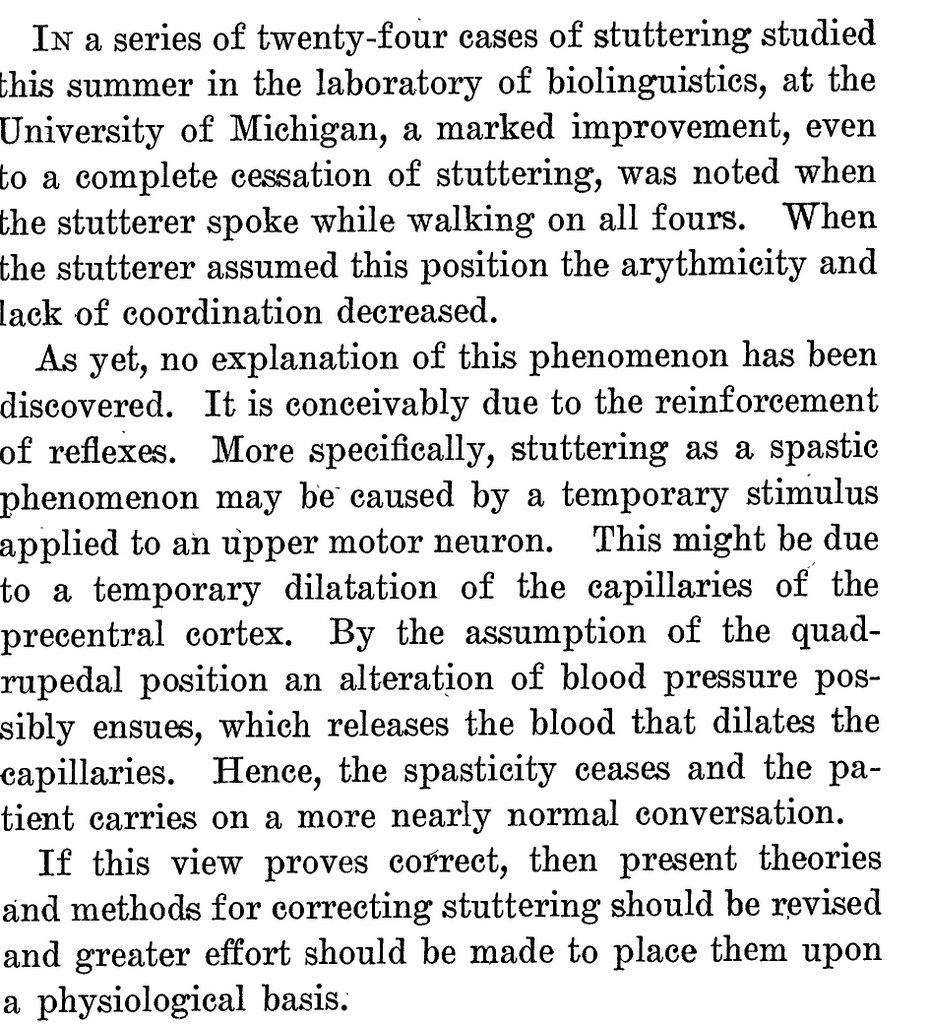
Oren aka The JellyFishKiller has sent me an article describing a cure for stuttering. I have tried it, and it works very well!!!!! So this is going to be my last post.

Here is the screenshot of the article (author is Hazle Geniesse, University of Michigan)


(Credit goes to Oren's labmate Jay Bohland (http://cns.bu.edu/~jbohland). The article was published in 1935: Science, New Series, Vol. 82, No. 2135 (Nov. 29, 1935), p.518 )

Out of ideas

I am completely out of ideas for posts... :-)

Anyone has a suggestion?

Monday, April 24, 2006

Web experiments

Sorry, I am not posting a lot currently... I am out of ideas.

But, yesterday, I had an interesting idea! One of the biggest problems for researchers (in general and in stuttering) is to get enough people to participate in their experiments. Typically, you need between 10 and 20 people, and often one control group and one stuttering group. This is not easy, and you need to advertise your experiment, get 20-30 people to agree to participate, schedule 20-30 meetings, and do 20-30 experiment.

Why can you not do the experiments via the web? You can reach many more people, and 20-30 will always participate. The easiest experiments are questionaires: just create a webpage with a form structure and a database behind. This is a standard technique. But you can also do more sophisticated experiments. For example, the experimental subject uses a software where he needs to press some button or react to a visual stimuli. Such software can be written in Java, and using Java Web Start they run on your computer via your webbrowser.

But as with all interesting ideas, the idea is 5%, and 95% is implementation... :-)

Wednesday, April 19, 2006

Make a donation

You have probably noticed that I have installed a donation button.

I spend a lot of time and money researching and attending conferences as a self-financed researcher. There might be a few of you who want and have the means to support me. I am testing whether this could be a means of getting money. Any donation would go towards my new project. I want to create a website dedicated to stuttering research.

If you want to invest serious money in advancing stuttering research, please contact me under tom.weidig "@" physics.org! I'll be happy to advise.

P.S. Let's hope a few Sultans stutter or their kid stutter AND read my blog! There must be some who stutter! :-)

Monday, April 17, 2006

Carl explained?

So here is my possible interpretation of Carl's introspection: see last post, too.

...I've often noticed (through introspection) that when my mind races and I have a hard time focusing, I stutter;
When we are in a more emotional state, we have less control over our motor and cognitive functions. And we are more slaves of our emotions, which was very important for our survival thousands of years ago. Also, you are more likely to have a racing mind when you have a bad day. Even "normal" people stutter when under extreme stress or emotions, but we just have a very low threshold.


when I force myself to say one-word-after-another, cancelling all blocks with great deliberation, I seemingly stutter more badly for the first seconds, and then, if I allow my mind to slow down and go into synch with my speech, I'm completely fluent.
I have similar experiences.

1) What you describe, sounds like a transition from one system to another. You go from your old car, which is very slow, to your new car, at first, you are slower driving your new car as you need to get used to the new car. Or you fire a bad employee, and hire a good one, but it needs time for the good one to become more effective. Thus, the phenomena of it getting worse before getting better is a very very general phenomena.

2) The same phenomena will happen if you switch to singing, chorus reading, reading, voluntary stuttering, acting, speaking loud and so on: see what Per thinks here. You switch your focus to how you say things.


To summarise, you start out the day without thinking about how to speak, you focus on the message, you notice that you stutter, you switch to a different mode, this causes you initial problems, then you are fully tuned into the mode, and you are more fluent.

This is all at a very slow pace. If I continue with that, resisting my extremely strong urges to lose focus on a single thought-process, and see each word in my mind before I say it, it becomes easier within a few minutes, and I can speed up just a bit. If I continue this with various strangers throughout the day (also using breathing techniques), I'm almost completely fluent by the end of the day.
The more you are tuned into the mode, the easier it becomes. And also, you are less concerned by your speech, and you become more relaxed which also makes it easier.


The urge of the mind to skip back into its default, unfocused, stuttering "track" remains, but will presumably lessen or go away with time.
This is also a very general phenomena. Take eating chocolate or starting jogging. At first, it is hard, and then it become easier. But there is still an urge to go back, and eventually you succumb to it slowly but surely.


To summarise, what Carl describes are very general phenomena happening in many different non-stuttering situations. Though they are not very important from a science point of view. But the most important insight is to ask why he becomes more fluent in this new mode. And here there is one theory, revived by Per Alm, that we have two system: one unstable automatic speech and one normal for active-control-over-how-we-say-it speech.

Saturday, April 15, 2006

Can introspection help?

Carl Joakim Gagnon has posted the following question:

I'd like a post on how you see the general relation between neuroscience and that oldest guide to how the mind works, introspection. Surely the only way to even design and understand experiments is coming at them from both angles?

...I've often noticed (through introspection) that when my mind races and I have a hard time focusing, I stutter; when I force myself to say one-word-after-another, cancelling all blocks with great deliberation, I seemingly stutter more badly for the first seconds, and then, if I allow my mind to slow down and go into synch with my speech, I'm completely fluent. This is all at a very slow pace. If I continue with that, resisting my extremely strong urges to lose focus on a single thought-process, and see each word in my mind before I say it, it becomes easier within a few minutes, and I can speed up just a bit. If I continue this with various strangers throughout the day (also using breathing techniques), I'm almost completely fluent by the end of the day. The urge of the mind to skip back into its default, unfocused, stuttering "track" remains, but will presumably lesson or go away with time.

So that's the introspection side of things. Any way to relate that first-hand report to neuroscience (to approach the problem from the other angle)?

Here are my views on the use of introspection or first-person reports.

1) There is no conflict whatsoever between a first-person experience (introspection) and a third-person science.

2) A first-person report is never wrong as long as the report only contains experiences. For example, no-one can tell you that your statement "I like Tom's blog", "I am not scared when I stutter", or "I like pink" is wrong.

3) Can you use such first-person reports in helping to advance third-person science? I always listen to first-person reports as they may offer food for thought and inspiration to look for new avenues. However, I am playing with the devil because even if you are a professionally trained thinker / scientist you will almost inevitably commit logical fallacies when trying to generalise the first-person report or your experience to a population.

4) To summarise, introspection of my own experience or a first-person reports can be a useful inspiration to construct theories, but they need to be tested with the scientific method.

5) Here are some of the pitfalls that I constantly encounter:

a. You cannot know whether an effect is present in all stutterers or only specific to the person who gives the first-person report. You can only find that out by doing a statistical analysis.

b. Reports might use the same words, but they might be different meaning. The words are very loosely defined. Your fear of a threat is not my fear of embarrassment. Your block is my slight hesitation.

c. Memories gets re-written every time they are re-called, and many memories are a mixture of a seed of true memory, and post-hoc interpretation.

d. Virtually always the reports are not actually reports of immediate experiences but a coherent story that your mind has woven from experiences and interpretation of what the gaps could be. The readers of first-person reports finds the untangling very difficult and tricky.

e. The greatest pitfall I see with introspection is the logical fallacy "Correlation is not necessarily causation". For example, "I started stuttering when my brother was born, and hated not being the focus of attention anymore" are factually correct, but for many this sounds like great evidence for a conflict between siblings being the cause of my stuttering". But I could also have written "I started stuttering [at age 3 at the age everyone starts stuttering]", "my brother was born [when I was age three which is not very surprising as parents have children at a 2-3 year interval], and "I hated not being the focus of attention anymore [like millions of other kids]". Now suddenly correlation between the three statements sounds like a coincidence and not like a casual link between them.

So to summarise, I use introspection or first-person reports for inspiration, but you are playing with the fire. And almost everyone that uses them gets burned. But luckily for them they don't notice the burns. :-)

Note: Some scientists refuse the use of introspection and first-person experiences as "impure science", but they are wrong. Playing with the fire can be highly insightful, if you are careful.

Friday, April 14, 2006

List of unsolved issues

I am currently editing a debate between Scott Yaruss and Mark Onslow. I want to share with you some of the questions that they have raised and are still unanswered by research.

Mark asked the following questions:

Why do repeated movements predominate at the onset of stuttering?

Why can stuttering be intractable for a lifetime?

Why do those who stutter have problems with tapping finger sequences?

Why do those who stutter have the problem while playing wind instruments?


Scott Yaruss has given an even longer list of questions with references. (Please note that especially the references are "from the top of his head")

Why does stuttering behavior start in children at a time of rapid expansion in linguistic, motoric, and temperamental aspects of their development (see the work of Conture, Yairi, and many others)?

Why do people who stutter react to stuttering in the way they do (see the work of Cooper, Manning, Murphy, Quesal, Sheehan, Williams, and others)?

Why does the occurrence of stuttering behavior seem to be so closely linked with aspects of language planning in both young children and adults (see the work of Bernstein Ratner, Conture, Hall, Howell, Logan, and others)?

More specifically, why are the loci of stuttering moments not distributed randomly with respect to linguistic, situational, and experiential variables (too many references to list)

What is the meaning, in particular, of the apparent linguistic associations in the loci of stuttering?

Why do people who stutter show differences in motoric stability (Smith) and linguistic processing, even when they are not engaged in speaking tasks (Weber-Fox) and why do these factors appear to interact?

Why do people who stutter show differences in neural functioning and possibly even structure (Blomgren, DeNil, Foundas, Fox, Ingham, Maguire, Riley, Watson, and others)?

What is the meaning of the temperamental differences between children who stutter and children who do not stutter that have recently been highlighted (Conture, Oyler, others)?

What of the fact that multiple loci seem to be implicated in genetic modeling of stuttering (Ambrose, Cox, Drayna, Felsenfeld, Yairi, and more)?

Wednesday, April 12, 2006

Covert working

Sorry, I have not been posting a lot over the last weeks. But, strangely enough my visitor numbers kept high. I have been busy working on my flat that I bought in Luxembourg-City. If you ever are close to Luxembourg, let me know and you are invited to stay at my place, but only if you are a stutterer, researcher, or (female) therapist! :-)

But I have also been busy working secretly in the background on stuttering research.

First, I am organsing a research plenary with talks and discussion forum at this year's British Stammering Association (BSA) conference in Telford. I was able to get leading researchers of different areas coming to Telford. I'll tell you more about this exciting event once the details are sorted out.

Second, I have been editing the debate between Scott Yaruss and Mark Onslow on therapy approaches to childhood stuttering. The debate will appear in Speaking Out, the BSA magazine. The editing took hours, but now I understand the arguments put forward much better! I'll probably post the debate on my blog piece-wise if the BSA editor gives his OK.

And finally, I am working on my presentation and proceeding contribution for IFA 2006 in Dublin. Here is the abstract I sent in

ABSTRACT:

I discuss how best to do the statistical analysis of the outcome data of early childhood intervention. The natural recovery rate of dysfluent children significantly complicates the statistical study of the outcome data. I argue that the standard random control trial setup needs to be modified, because children are randomly assigned to the treatment or control group and by chance one group will have a higher natural recovery rate. I also point out other conceptual difficulties when using a randomized control trial setup. Finally, I suggest that there is no need for a control group, also because other studies have already determined the natural recovery rate.


But really it's a bit of nonsense to ask for an abstract months before the conference. I will only loosely stick to the abstract. Most researchers are writing the abstract before they write the presentation and paper!

Sunday, April 09, 2006

Food and Stuttering

Stuttering has been linked to many different factors. Here is another one, from the post on the STUTT-L mailing list by Melinda Poland-Kayira, Graduate Student in Speech Pathology:

"When doing some research online, I came across a suggestion that sensitivity to certain foods affects stuttering, and if those foods are identified and eliminated, stuttering will reduce. The source of this suggestion was the blog of a woman who states that her son was a severe stutterer, and after eliminating problem foods from his diet, he no longer stuttered. She stated that food sensitivities can interfere with language processing.
(http://www.stopstutterdiet.blogspot.com/)

I am familiar with gluten-free, casein-free diets recommended for children with autism; however, I was not aware of a diet to reduce stuttering. My question is: is anyone aware of any research that has been done to evaluate a correlation between diet and stuttering?"


It is possible that special diets influence the severity of stuttering by changing the general fitness of the brain, hormonal levels or neurotransmitter levels. Not sure by how much. But if such a diet existed, a medication could probably do the same.

But for the moment, I'll stick to my daily cholocate hit to ease the terrible suffering caused by stuttering... :-)

Thursday, April 06, 2006

Interesting meetings on medication

Holger Stenzel sent me these interesting meeting dates on medication.

ASHA SID 4 Leadership Conference, May 31 - June 3, 2006, San Antonio, TX.
Blomgren, M. (2006). Pharmacologic treatments of stuttering: Recent research and current findings. Invited presentation.

46th Annual New Clinical Drug Evaluation Unit (NCDEU) Meeting, June 12-15, 2006, Boca Raton, FL.
Maguire, G., Riley, G., Franklin, D., Blomgren, M., Soni, P., Yaruss, S., Denko, T., Davis, L., Davis, A., Silverman, A., Sabounjian, L., & Shipley, J. (2006). Enhancing precision in clinical trials: Methodological issues in assessing the pharmacologic treatment of stuttering.

5TH WORLD CONGRESS ON FLUENCY DISORDERS, 25 – 28th July, 2006, Dublin, Ireland
Gerald Maguire, Glyndon Riley and David Franklin
Pharmacologic Strategies in the Treatment of Stuttering
Abstract: Stuttering is classified in the psychiatric nomenclature of DSM-IV. In spite of such, relatively little research has been conducted into possible psychopharmacologic treatments. Clinical trials utilizing double-blind, placebo-controlled designs have found that novel dopamine blocking agents are effective in reducing the severity of stuttering but are associated with significant side-effects. The most comprehensive pharmacologic trial to date in stuttering has recently been completed and evaluated the efficacy and safety of pagoclone, a novel nonbenzodiazepine GABA partial agonist with a unique mechanism and the potential to provide a favorable safety profile. Data from this multi-center, double-blind, placebo-controlled trial will be presented.

National Stuttering Association
Annual Conference 2006, June 28 - July 1, 2006 in Long Beach, California.
Keynote speaker:
Dr. Maguire will discuss with his fellow NSA members not only the latest in research investigating pharmacologic treatments for stuttering but also his own personal journey as a person who stutters.

Sunday, April 02, 2006

Tom and The JellyFishKiller


I am back from skiing, and still alive! I love skiing...

Oren Civier, a graduate student at Boston University, just sent me a picture of us at the Oxford Disfluency Conference last summer. He also included a picture with him and Per Alm, but I prefer to put up the picture where I am on it! Sorry Per... it is not me it is my subcortical structures... ;-)

The Internet is such a wonderful invention. Especially when googling people. For example, I just found out that Oren is on Internet Chat and his nick name is JellyFishKiller! :-o Check this out. Apart from his morally suspicious jelly fish killings, he works on neural models for stuttering. (Here is the link to his publications. They are more mathematical.)

He asked me whether he should go to the IFA conference in Dublin or the speech motor control conference in Nijmengen. The difference between the two conference is that IFA 2006 is much broader and covers everything on stuttering: from personal experiences to hard-core science. The Nijmengen conference is only science and focussed on speech-motor control.