This blog is going on a roadshow. Here are the different cities:
June 1st to June 3th: Pisa (Italy)
June 4th: Frankfurt (Germany)
June 5th to June 7th: New York (USA)
June 8th to June 11th: Boston (USA)
If you wanne meet up, let me know!!! :-)
P.S. I am going to a wedding in Italy, and fly to NY for a consultancy job, and Boston to meet several people.
Tuesday, May 30, 2006


Saturday, May 27, 2006
Were you a stuttering guinea pig?
If you have participated in the Pagoclone trials, I (and I am sure the other readers) would like to hear from you. Either leave a comment or send me an email. I can make the report anonymous on request.
Ideally the report should tell us about:
1. yourself and your stuttering before the trials,
2. about the procedures and your contacts with the trial managers,
3. about your experiences during the trial and comments by others on your speech.
4. whether you would continue on Pagoclone.
It is important that you only report what you have experienced and comments by others. If you also want to share your interpretation of your experiences, it is crucial that you clearly separate them from your experiences. For example: Instead of "I was more fluent while on Pagoclone", "I took the pills and soon after I felt that I spoke more fluent, but did not ask my wife or others for independent feedback. I am fairly confident that I took Pagoclone and not a placebo, because I felt differently and was less anxious. I also think that I truely became more fluent. So I associate my experience of greater fluency to Pagoclone."
Ideally the report should tell us about:
1. yourself and your stuttering before the trials,
2. about the procedures and your contacts with the trial managers,
3. about your experiences during the trial and comments by others on your speech.
4. whether you would continue on Pagoclone.
It is important that you only report what you have experienced and comments by others. If you also want to share your interpretation of your experiences, it is crucial that you clearly separate them from your experiences. For example: Instead of "I was more fluent while on Pagoclone", "I took the pills and soon after I felt that I spoke more fluent, but did not ask my wife or others for independent feedback. I am fairly confident that I took Pagoclone and not a placebo, because I felt differently and was less anxious. I also think that I truely became more fluent. So I associate my experience of greater fluency to Pagoclone."
Friday, May 26, 2006
Probing Pagoclone EXPRESS
I was told that a manuscript of the Pagoclone study will soon be published with more details, which will also allow a discussion on effect sizes. So we need to wait a bit. In the mean time...
I looked at the press release a bit more, here are my thoughts:
Jerry Maguire's statement is more revealing. My interpretation of his statement (which MIGHT BE COMPLETELY WRONG!) is the following: He is mostly excited about the trials, because it is the first large scale study that has been done and the drug shows more effects than any other drug but he is not excited because Pagoclone is a cure. And, not all stutterers benefit from Pagoclone, and those who do reduce their stuttering noticeably but do not eliminate it.
They have followed standard procedure.
EXPRESS (the name of the study) used the following measures:
Frequency and Duration Subscale of the Stuttering Severity Instrument Version 3 (SSI-3)
the Stuttering Severity Scale (SEV)
the Subjective Screening of Stuttering (SSS) Severity Subscore
the Clinician Global Impression-Improvement (CGI-I)
the Liebowitz Social Anxiety Scale (LSAS)
the Speech Naturalness Scale (SNS)
They claim that the measures ( SSI-3, SEV, and SSS) are validated stuttering measures.
My question:
What do they mean by "validated"? Have they done a battery of statistical checks to see how consistent the measure is? My experience is that the stuttering measures taken at week 0 are NOT normally distributed, and there are some significant outliers, i.e. some stutterers are extremely disfluent or fluent. A massive improvement of 1-2 extreme stutterers give statistical significant results for the whole group.
For all measures except SEV, the distributions of measured values for the control group and the placebo group were statistically significantly different at p-values ranging from 0.007 to .08; (typically p=0.05 is regarded as "worth noting" as only 1:20 is the result of a statistical fluctuation, and p=0.01 is considered "reliable").
My question:
1) What happens if you give the medication to normal people? I would guess that their CGI-I and LSAS would improve, too?
2) I want to see the effect size, i.e. I want to know how big the effect is.
3) Is the effect only for some people or all people?
The SEV measure is rated by clinicians from "no stuttering" to "extremely severe". They write: "The on-treatment effect of patients receiving pagoclone demonstrated a numerically superior rating versus patients treated with placebo (p=.18)."
My question:
The p-value is quite high, p=.18, which means that there is a 20% probability that the effect does not exist and is due to statistical fluctuation (i.e. chance).
On SSS, they write "The SSS Severity Subscore, measured at week 2, week 4 and week 8, is a validated, patient-rated assessment of stuttering that takes into account specific speaking situations that have taken place over the prior week. Pagoclone produced a statistically significant reduction at week 2 (p=.004) and week 4 (p=.05) and a trend for significant improvement at week 8 (p=.08) as compared to placebo."
My question:
What is interesting is that the p-values go up with time, from p=0.004, to p=0.05 to p=0.08. This makes me a bit suspicious that they experience a high / placebo effect which decreases with time. Listening at the reports from patients, they pretty well all know whether they are on Pagoclone or not, even though it is blind. So they might experience a high in their subjective assessment of fluency. This possibility can be eliminated by 4-months data.
I looked at the press release a bit more, here are my thoughts:
“Indevus has completed what we believe is the largest pharmaceutical trial ever conducted for stuttering and the results are very exciting,” stated Glenn L. Cooper, M.D., chairman, president and chief executive officer of Indevus. “Our results today show that stuttering, a condition with no approved pharmacological treatment, is potentially treatable with Pagoclone. This study was designed as an exploratory trial to follow up on a limited number of observations of the effect of Pagoclone on stuttering during previous anxiety trials. The design of the EXPRESS trial enabled us to evaluate the condition from several clinical perspectives and we believe this provides us with a strong foundation to develop a clinical plan for further development.”He says a lot without saying anything... He could be French or a politician... :-)
Gerald A. Maguire, M.D., associate professor, department of psychiatry, University of California, Irvine School of Medicine, stated, “Being a person who stutters and a physician who researches and treats stuttering, I am very excited about the results of this trial. As an investigator on this study, I saw first hand the positive impact pagoclone can have on the lives of patients. Consistent with the results of the entire study sample, more than half of my pagoclone treated patients had a clinically meaningful decrease in the severity of their stuttering. Although there is no cure for stuttering, pagoclone holds significant promise as a well-tolerated, effective and viable treatment for the millions of Americans who stutter.”
Jerry Maguire's statement is more revealing. My interpretation of his statement (which MIGHT BE COMPLETELY WRONG!) is the following: He is mostly excited about the trials, because it is the first large scale study that has been done and the drug shows more effects than any other drug but he is not excited because Pagoclone is a cure. And, not all stutterers benefit from Pagoclone, and those who do reduce their stuttering noticeably but do not eliminate it.
8-week, placebo controlled, double-blind, multi-center trial with an open label extension. There were a total of 132 patients randomized in the trial.
They have followed standard procedure.
EXPRESS (the name of the study) used the following measures:
Frequency and Duration Subscale of the Stuttering Severity Instrument Version 3 (SSI-3)
the Stuttering Severity Scale (SEV)
the Subjective Screening of Stuttering (SSS) Severity Subscore
the Clinician Global Impression-Improvement (CGI-I)
the Liebowitz Social Anxiety Scale (LSAS)
the Speech Naturalness Scale (SNS)
They claim that the measures ( SSI-3, SEV, and SSS) are validated stuttering measures.
My question:
What do they mean by "validated"? Have they done a battery of statistical checks to see how consistent the measure is? My experience is that the stuttering measures taken at week 0 are NOT normally distributed, and there are some significant outliers, i.e. some stutterers are extremely disfluent or fluent. A massive improvement of 1-2 extreme stutterers give statistical significant results for the whole group.
For all measures except SEV, the distributions of measured values for the control group and the placebo group were statistically significantly different at p-values ranging from 0.007 to .08; (typically p=0.05 is regarded as "worth noting" as only 1:20 is the result of a statistical fluctuation, and p=0.01 is considered "reliable").
My question:
1) What happens if you give the medication to normal people? I would guess that their CGI-I and LSAS would improve, too?
2) I want to see the effect size, i.e. I want to know how big the effect is.
3) Is the effect only for some people or all people?
The SEV measure is rated by clinicians from "no stuttering" to "extremely severe". They write: "The on-treatment effect of patients receiving pagoclone demonstrated a numerically superior rating versus patients treated with placebo (p=.18)."
My question:
The p-value is quite high, p=.18, which means that there is a 20% probability that the effect does not exist and is due to statistical fluctuation (i.e. chance).
On SSS, they write "The SSS Severity Subscore, measured at week 2, week 4 and week 8, is a validated, patient-rated assessment of stuttering that takes into account specific speaking situations that have taken place over the prior week. Pagoclone produced a statistically significant reduction at week 2 (p=.004) and week 4 (p=.05) and a trend for significant improvement at week 8 (p=.08) as compared to placebo."
My question:
What is interesting is that the p-values go up with time, from p=0.004, to p=0.05 to p=0.08. This makes me a bit suspicious that they experience a high / placebo effect which decreases with time. Listening at the reports from patients, they pretty well all know whether they are on Pagoclone or not, even though it is blind. So they might experience a high in their subjective assessment of fluency. This possibility can be eliminated by 4-months data.
Thursday, May 25, 2006
Before I take Pagoclone
... I would set myself 10 criteria that the medication needs to satisfy. Here are they plus my arguments.
1) The drug has been commercially available for 3-5 years without major negative news and gossip. I want to see whether Pagoclone survives the reality test away from random control trials with well-briefed doctors and especially-selected patients. The commercial use must not necessarily be for stuttering.
2) I convinced myself that the effect size is large. Taking any medication is about balancing risks, and I am only willing to take the risks on (known and unknown long-term) side effects if the effect of Pagoclone is significant (not just a bit more fluent) and lasting.
3) I convinced myself that the effect is not just due to what Pagoclone has been designed for anti-anxiety. It is possible that the positive effect claimed is due to the anti-anxiety effect. Effectively, patients know that they are on Pagoclone, because they become more relaxed. And then the placebo effect also sets in, and together greater fluency is achieved. Also, I rarely experience anxiety, and I am wondering what the drug would do to me mentally. Am I going to turn into a wild inhibited animal? :-)
4) I convinced myself that a scientific study of long-term user of Pagoclone has shown minimal and reversible side effects. My stuttering does affect my life and reduces my potential in certain situations, but I do not think I would trade more fluency with weight gain, headaches, or other effect lightly.
5) The FDA has made a positive statement on side effects and for use to treat stammering. But I would still be hesitant. I spent a lot of efforts to understand stuttering, and the issues are damm complex. So I cannot see how the generalist FDA would understand the issue better, on the contrary. So I would not trust them on what they have to say about its use for treating stuttering, but most certainly on their statements regarding side effects.
6) Neurologists or other related experts not linked in any way to Indevus recommend its use. Stuttering is potentially a multi-million market, and a lot of recognition for the involved researchers / doctors. Also, Indevus has spent a lot of money on these trials. This is just a precaution, and a best practise in any risk management. Wishful thinking and money are always a very strong motivator to twist and spin. Always ask outsiders for a second opinion.
7) Neurologists or other related experts who STUTTER themselves use Pagoclone to treat their own stuttering!!!! :-) This would be strong evidence that Pagoclone is effective and safe. They are professionals and know the realities, and are able to make a much better judgement call than myself.
8) The hype and discussions on Pagoclone are over. Currently, we are in a hype period. News came out, and many journalists are picking it up. They are no experts, and need to simplify issues for the reader. So expect white and black comments rather than greyish. Such comments will be taken on, and this will lead to strong clear-cut opinions being formed. So it is always best to wait for things to cool down until everyone is bored about it!!
9) I have personally spoken to 2-3 people who took / are taking Pagoclone. Scientific studies are crucial, but talking to actual people is a very insightful reality check.
10) Pagoclone does not delay or inhibit ejaculation. Indevus wants to sell Pagoclone to treat men with pre-ejaculation. Then the question arise whether normal man are also impacted? If so and in a significant way, I would need to think hard about this one.
1) The drug has been commercially available for 3-5 years without major negative news and gossip. I want to see whether Pagoclone survives the reality test away from random control trials with well-briefed doctors and especially-selected patients. The commercial use must not necessarily be for stuttering.
2) I convinced myself that the effect size is large. Taking any medication is about balancing risks, and I am only willing to take the risks on (known and unknown long-term) side effects if the effect of Pagoclone is significant (not just a bit more fluent) and lasting.
3) I convinced myself that the effect is not just due to what Pagoclone has been designed for anti-anxiety. It is possible that the positive effect claimed is due to the anti-anxiety effect. Effectively, patients know that they are on Pagoclone, because they become more relaxed. And then the placebo effect also sets in, and together greater fluency is achieved. Also, I rarely experience anxiety, and I am wondering what the drug would do to me mentally. Am I going to turn into a wild inhibited animal? :-)
4) I convinced myself that a scientific study of long-term user of Pagoclone has shown minimal and reversible side effects. My stuttering does affect my life and reduces my potential in certain situations, but I do not think I would trade more fluency with weight gain, headaches, or other effect lightly.
5) The FDA has made a positive statement on side effects and for use to treat stammering. But I would still be hesitant. I spent a lot of efforts to understand stuttering, and the issues are damm complex. So I cannot see how the generalist FDA would understand the issue better, on the contrary. So I would not trust them on what they have to say about its use for treating stuttering, but most certainly on their statements regarding side effects.
6) Neurologists or other related experts not linked in any way to Indevus recommend its use. Stuttering is potentially a multi-million market, and a lot of recognition for the involved researchers / doctors. Also, Indevus has spent a lot of money on these trials. This is just a precaution, and a best practise in any risk management. Wishful thinking and money are always a very strong motivator to twist and spin. Always ask outsiders for a second opinion.
7) Neurologists or other related experts who STUTTER themselves use Pagoclone to treat their own stuttering!!!! :-) This would be strong evidence that Pagoclone is effective and safe. They are professionals and know the realities, and are able to make a much better judgement call than myself.
8) The hype and discussions on Pagoclone are over. Currently, we are in a hype period. News came out, and many journalists are picking it up. They are no experts, and need to simplify issues for the reader. So expect white and black comments rather than greyish. Such comments will be taken on, and this will lead to strong clear-cut opinions being formed. So it is always best to wait for things to cool down until everyone is bored about it!!
9) I have personally spoken to 2-3 people who took / are taking Pagoclone. Scientific studies are crucial, but talking to actual people is a very insightful reality check.
10) Pagoclone does not delay or inhibit ejaculation. Indevus wants to sell Pagoclone to treat men with pre-ejaculation. Then the question arise whether normal man are also impacted? If so and in a significant way, I would need to think hard about this one.
Wednesday, May 24, 2006
Results from Pagoclone!!! Why no effect size??
My secret agents (The JellyFishKiller and The Junkie) are telling me that Indevus has made public the results of the Phase II trial of Pagoclone. I have been talking about Pagoclone extensively: for example here.
I had a quick look at their press release, but find it hard to interpret. I am extremely puzzled that they only talk about statistical significant difference (which measures whether control and treatment groups are different) rather than effect size (which measures how big the difference is in terms of statistical significance). This leaves me speculating that there are problems with the effect size: either it is not very high (i.e. lower than 0.2) or it is methodically difficult to compute. Another option is that they are simply not aware of the relevance of effect size, but that would be very strange for a multi-million company. God knows... So I need to know more about the trials before making a more definite judgement. However, on the social anxiety side, they seem to be most confident of a significant effect. Also, there are several mostly positive reports from participants of the trial.
The following except is taken from the Indevus website on May 24th. I could not link to this document. And you should look for it on the website.
I had a quick look at their press release, but find it hard to interpret. I am extremely puzzled that they only talk about statistical significant difference (which measures whether control and treatment groups are different) rather than effect size (which measures how big the difference is in terms of statistical significance). This leaves me speculating that there are problems with the effect size: either it is not very high (i.e. lower than 0.2) or it is methodically difficult to compute. Another option is that they are simply not aware of the relevance of effect size, but that would be very strange for a multi-million company. God knows... So I need to know more about the trials before making a more definite judgement. However, on the social anxiety side, they seem to be most confident of a significant effect. Also, there are several mostly positive reports from participants of the trial.
The following except is taken from the Indevus website on May 24th. I could not link to this document. And you should look for it on the website.
INDEVUS ANNOUNCES PROMISING PHASE II DATA FOR PAGOCLONE IN STUTTERING
Compound Achieves Multiple Primary and Secondary Endpoints and is Well-Tolerated
LEXINGTON, MA, May 24, 2006 – Indevus Pharmaceuticals, Inc. (NASDAQ: IDEV) today announced top line results from the Company’s Phase II clinical trial for pagoclone in persistent developmental stuttering. Results from the trial show that pagoclone produces a statistically significant benefit in multiple primary and secondary endpoints compared to placebo. Additionally, pagoclone produced either numerically superior improvement or trends for significant improvement on virtually all other primary and secondary endpoints when compared to placebo. Pagoclone was also shown to be well tolerated and not associated with any serious adverse events.
The Phase II trial, known as the EXPRESS study, was an 8-week, placebo controlled, double-blind, multi-center trial with an open label extension. There were a total of 132 patients randomized in the trial. Eighty-eight patients received escalating doses of pagoclone from 0.3 mg to 0.6 mg per day. Forty-four patients received placebo. Seventy-nine percent of the patient population was male which is reflective of the gender distribution of this disorder.
As a result of the promising outcome of this study, the Company plans to meet with the FDA in an End of Phase II meeting to discuss the findings and its plans for further clinical development.
“Indevus has completed what we believe is the largest pharmaceutical trial ever conducted for stuttering and the results are very exciting,” stated Glenn L. Cooper, M.D., chairman, president and chief executive officer of Indevus. “Our results today show that stuttering, a condition with no approved pharmacological treatment, is potentially treatable with pagoclone. This study was designed as an exploratory trial to follow up on a limited number of observations of the effect of pagoclone on stuttering during previous anxiety trials. The design of the EXPRESS trial enabled us to evaluate the condition from several clinical perspectives and we believe this provides us with a strong foundation to develop a clinical plan for further development.”
Gerald A. Maguire, M.D., associate professor, department of psychiatry, University of California, Irvine School of Medicine, stated, “Being a person who stutters and a physician who researches and treats stuttering, I am very excited about the results of this trial. As an investigator on this study, I saw first hand the positive impact pagoclone can have on the lives of patients. Consistent with the results of the entire study sample, more than half of my pagoclone treated patients had a clinically meaningful decrease in the severity of their stuttering. Although there is no cure for stuttering, pagoclone holds significant promise as a well-tolerated, effective and viable treatment for the millions of Americans who stutter.”
The primary endpoints evaluated in the double-blind, phase of the study were the Frequency and Duration Subscale of the Stuttering Severity Instrument Version 3 (SSI-3), the Stuttering Severity Scale (SEV) and the Subjective Screening of Stuttering (SSS) Severity Subscore. Given that this was an exploratory study, pre-specified analyses utilized 1-tailed tests of significance.
The SSI-3 is a validated measure of stuttering. During study visits at week 4 and week 8, patients were videotaped while engaged in both a conversational and reading task. The videotapes were analyzed and scored at a central laboratory. Raters were blinded with regard to treatment and visit. The frequency and duration subscales were calculated by measuring the proportion of syllables stuttered compared to syllables spoken and the length of time of each stuttering block or event. The variability of stuttering naturally tends to wax and wane over time. Accordingly, two data points were collected prior to treatment and two data points were collected while on treatment at week 4 and week 8 to determine the on-treatment effect of pagoclone. The on-treatment effect of pagoclone was shown to produce a statistically significant reduction in the frequency and duration of stuttering as measured by the SSI-3 scale when compared to placebo (p=.02).
The SEV, measured at week 2, week 4 and week 8, is a validated measure of stuttering. The SEV is a 9-point, clinician rated severity scale anchored by “no stuttering” and “extremely severe stuttering”. The on-treatment effect of patients receiving pagoclone demonstrated a numerically superior rating versus patients treated with placebo (p=.18).
The SSS Severity Subscore, measured at week 2, week 4 and week 8, is a validated, patient-rated assessment of stuttering that takes into account specific speaking situations that have taken place over the prior week. Pagoclone produced a statistically significant reduction at week 2 (p=.004) and week 4 (p=.05) and a trend for significant improvement at week 8 (p=.08) as compared to placebo.
The secondary endpoints evaluated in the study included the Clinician Global Impression-Improvement (CGI-I), the Liebowitz Social Anxiety Scale (LSAS) and the Speech Naturalness Scale (SNS).
The CGI-I, measured at week 2, week 4 and week 8, is a 7-point, validated and widely accepted clinician-rated measure of improvement as compared to baseline, considering all sources of available clinical information about the patient. For analysis of the improvement in the severity of stuttering, patients were categorized as having either “improved” versus “no change or worsened”. Pagoclone produced numerically superior improvement at week 2 (p=.20) and statistically significant improvement at week 4 (p=.007) and at week 8 (p=.02) as compared to placebo. At week 8, 55% of pagoclone treated patients were improved compared to 36% of placebo treated patients.
The LSAS, measured at week 4 and week 8, is a validated measure of social anxiety symptoms. Stuttering is often co-morbid with symptoms of social anxiety which can be a disabling consequence of stuttering. Although patients with primary anxiety disorders were excluded from participating in the trial, pagoclone produced a trend for significant improvement in social anxiety symptoms (total LSAS score) compared to placebo at week 4 (p=.09) and week 8 (p=.07). On a subscale comprised of the elements of the LSAS that evaluate anxiety-provoking speaking situations, pagoclone produced statistically significant improvement at both week 4 (p=.02) and week 8 (p=.02).
Pagoclone was shown to be safe and well-tolerated. There were no serious adverse events associated with pagoclone. The most commonly reported side effects associated with pagoclone were headache (12.5% for pagoclone and 6.8% for placebo) and fatigue (8% for pagoclone and 0% for placebo). As with all prior trials for pagoclone, reports of somnolence and sedation were similar between pagoclone and placebo. Additionally, pagoclone exerted its clinical effect on patients without disrupting the naturalness of their speech as assessed by the SNS, a validated 9-point scale.
Approximately 90% of patients continued into the open-label phase of the study in which all patients receive pagoclone. Early results of the open-label phase indicate that patients initially randomized to pagoclone have continued to show improvement in their stuttering and those initially randomized to placebo, and now receiving pagoclone, are exhibiting improvement in their condition.
Pagoclone is a novel, non-benzodiazepine, GABA-A selective receptor modulator. It is part of a new chemical class of agents and lacks many of the common benzodiazepine side effects such as sedation and withdrawal. The precise mechanism of action is unknown however, GABA is believed to be an important neurotransmitter in the brain that may be disrupted in people who stutter. Pagoclone enhances the activity in GABA circuits in the brain and thus may help restore more normal function in speech areas of the brain.
Tuesday, May 23, 2006
Not much happening
I am out of ideas for posts!!! :-)
Behind the scenes, I have been organising a research plenary for the BSA conference: more soon.
Then I will be in New York from June 5th to June 7th, and then in Boston until Friday June 10th. I hope to meet up with Prof Shell, who wrote a book on stuttering, and with someone else from the New York self-help group. Should be fun...
Behind the scenes, I have been organising a research plenary for the BSA conference: more soon.
Then I will be in New York from June 5th to June 7th, and then in Boston until Friday June 10th. I hope to meet up with Prof Shell, who wrote a book on stuttering, and with someone else from the New York self-help group. Should be fun...
Wednesday, May 17, 2006
Sex or fluency?
Recently I spoke about Pagaclone and how Indevus has registered the drug to reduce pre-ejaculation: see here.
But what is the effect on normal men? If Pagaclone delays ejaculation in pre-ejaculating men, then should not every men experience a shift in his typical ejaculation time. So normal men should have trouble to ejaculate, and man having trouble to ejaculate find it impossible.
So most stutterers might become more fluent, but experience problems with ejaculating / having an orgasm! So what is your choice? And, to the women, you rather have him stutter or ... ?
Of course, for stuttering pre-ejaculators the drug is absolute heaven: you become a fluent and a well-tuned sex god! :-)
But what is the effect on normal men? If Pagaclone delays ejaculation in pre-ejaculating men, then should not every men experience a shift in his typical ejaculation time. So normal men should have trouble to ejaculate, and man having trouble to ejaculate find it impossible.
So most stutterers might become more fluent, but experience problems with ejaculating / having an orgasm! So what is your choice? And, to the women, you rather have him stutter or ... ?
Of course, for stuttering pre-ejaculators the drug is absolute heaven: you become a fluent and a well-tuned sex god! :-)
Tuesday, May 16, 2006
Hardware vs Software problem?
Hardware is what has a clear physical manifestation: the brain cells, nerves, their general functions, and the functional organisation of a brain. Software is what is stored in the hardware and "runs" the hardware like: learned and innate behaviour, psychological processes, social issues. There is no clear transition between what is hardware and software.
Is PDS a hardware or a software problem?
1. The question contains a logical fallacy, as the question implies an either/or answer.
2. Do people who stutter have the same hardware, but only faulty software?
3. Do people who stutter have defective/suboptimal hardware?
4. If answer to 3) is yes, can a updated software correct the hardware weakness?
5. Do people who stutter start out with the same hardware, but their software gets corrupted and slowly but surely their hardware works suboptimal and then the hardware is part of the problem. For example, your car works fine, you drive like a maniac, car engine is misused, I drive the car, car doesn't drive very well?
6. Is there a continuum from 0% hardware problem and 100% software problem to 100% hardware and 0% software?
7. Is 0% hardware problem and 100% software problem not more likely that 100% hardware and 0% software? As I pointed out a hardware problem nearly always leads to software problems.
8. If there is a software problem, does it lead to permanent hardware problems?
9. Do people whether they say stuttering is a hardware or a software problem only reflect on their own stuttering and experience?
Is PDS a hardware or a software problem?
1. The question contains a logical fallacy, as the question implies an either/or answer.
2. Do people who stutter have the same hardware, but only faulty software?
3. Do people who stutter have defective/suboptimal hardware?
4. If answer to 3) is yes, can a updated software correct the hardware weakness?
5. Do people who stutter start out with the same hardware, but their software gets corrupted and slowly but surely their hardware works suboptimal and then the hardware is part of the problem. For example, your car works fine, you drive like a maniac, car engine is misused, I drive the car, car doesn't drive very well?
6. Is there a continuum from 0% hardware problem and 100% software problem to 100% hardware and 0% software?
7. Is 0% hardware problem and 100% software problem not more likely that 100% hardware and 0% software? As I pointed out a hardware problem nearly always leads to software problems.
8. If there is a software problem, does it lead to permanent hardware problems?
9. Do people whether they say stuttering is a hardware or a software problem only reflect on their own stuttering and experience?
Thursday, May 04, 2006
Epitaph Competition
My thinking is very much no-ideas-barred. I have been surfing the net, and found this list of epitaphs. So naturally I have been thinking about what epitaph I should put on my grave... Here are some ideas... looking forward to feedback!!
Top Five Epitaphs for Stutterers:
1. Here rests T--tt--- forget it.
2. Finally no more stuttering.
3. Here rests TT--- me who has the same first name as the one 2 gravestones to the left and the same family name as the one 3 gravestones behind mine
4. Here r--es-- ehh lays Tom Weidig.
5. Sorry I still dont maintain eye contact.
Any more suggestions... :-)
P.S.
Here is my favourite one that I found on the Internet.
Here lies George Johnson
Hanged by mistake, 1882
He was right
We was wrong
But we strung him up
And now he's gone
Top Five Epitaphs for Stutterers:
1. Here rests T--tt--- forget it.
2. Finally no more stuttering.
3. Here rests TT--- me who has the same first name as the one 2 gravestones to the left and the same family name as the one 3 gravestones behind mine
4. Here r--es-- ehh lays Tom Weidig.
5. Sorry I still dont maintain eye contact.
Any more suggestions... :-)
P.S.
Here is my favourite one that I found on the Internet.
Here lies George Johnson
Hanged by mistake, 1882
He was right
We was wrong
But we strung him up
And now he's gone
Monday, May 01, 2006
Hardware vs Software
I have been thinking about what it means that PDS is a psychological or a physical problem. Here are some thoughts:
1) If PDS has a physical cause, an additional psychological component (which may in turn aggravate the condition) very likely must emerge. For example, you are in a wheelchair, you also suffer psychologically. You have a big scar in your face, you also suffer psychologically, e.g. avoid people.
2) But if stuttering is purely psychological in origin, there are no obvious physical consequences.
3) In reality, stuttering even if psychological has a physical manifestation. The brain needs to store the memory, has learned new behaviour, and creates fears against change. The key question is whether this physical imprint on the brain is strong and not easily reversible (you engrave a epitaph on a gravestone) or weak and easily reversible (you store information on a floppy disk or black/whiteboard).
To better understand the dynamics, I am using the analogy between hardware and software. More soon...
1) If PDS has a physical cause, an additional psychological component (which may in turn aggravate the condition) very likely must emerge. For example, you are in a wheelchair, you also suffer psychologically. You have a big scar in your face, you also suffer psychologically, e.g. avoid people.
2) But if stuttering is purely psychological in origin, there are no obvious physical consequences.
3) In reality, stuttering even if psychological has a physical manifestation. The brain needs to store the memory, has learned new behaviour, and creates fears against change. The key question is whether this physical imprint on the brain is strong and not easily reversible (you engrave a epitaph on a gravestone) or weak and easily reversible (you store information on a floppy disk or black/whiteboard).
To better understand the dynamics, I am using the analogy between hardware and software. More soon...
Saturday, April 29, 2006
Crackpot No. 2

The Stuttering Brain proudly presents the second winner of the prestigious "The Stuttering Brain's Crackpot Award": Stephen Hill aka Tony Blair II. (Click here for the first winner.)
The Stuttering Brain proudly declares in his eulogy:
"Stephen Hill is a creative genius of marketing per excellence. He managed to get into many UK newspapers by explaining how thinking about Tony Blair buying a burger helped him overcome his stutter. He claims "I would love to be able to report 95-100% success, however I believe it is more like 85%. To achieve fluency takes a lot of hard work and practice, unfortunately not all of my clients seem willing to put this effort in.", and with one stroke isolates himself from any criticism: if you dont succeed, you only have to blame yourself. The Stuttering Brain is convinced that Stephen Hill is misleading potential clients by claiming 85% success rate. His methods are also remarkable: "I achieved fluency by concentrating on how fluent people spoke. Therefore my method is speaking, thinking, and breathing how fluent people do." So the way to speak like normal people is to speak like normal people. WOW!
Please note, that Stephen Hill is not the son of the UK comedian, Benny Hill, whose most famous feats involved being chased by semi-naked young girls. He is not a comedian, but gets paid for advice by people desperate to get rid of their stuttering."
P.S. The award aims to name and shame people for outrageous claims about PDS, especially those that try to make money out of promises for a cure.
Thursday, April 27, 2006
NPL/Neurosemantics.
Adrian has suggested I should speak out on NLP/Neurosemantics. He wrote in his comment:
Yes, Bodenhamer is on my watchlist! :-) He wrote an article in Speaking Out, and I am hoping to wrote a Letter to the Editor. I am short of time. To summarise, NLP/Neurosemantics or any other techniques like auto-suggestion and motivational techniques are very useful to change behaviour, and so are helpful in achieving more fluency. However, Bodenhamer and other practitioners are pushing it far too hard: see cure or we understand stuttering. His statement in Speaking Out on the nature of stuttering are ill informed and ignorant of the new research coming out. If it is all in the mind, so how come genetics matters. How come the brain scans of people who stutter are different? How come they are worse in dual tasks? More soon..
I would be interested in hearing your views on the application of NLP/Neurosemantics in the treatment of stuttering. These approaches to stuttering have become wildly popular in recent years. Well known NLP practitioner Tony Robbins has claimed to have cured stuttering in one session. Bob Bodenhamer of Neurosemantics has claimed to have cured stuttering in two phone sessions. These are lofty claims that I have a difficult time believing. The "therapy" is based on the idea that stuttering is a cognitive problem with no physical or neurological correlate and once you have your head screwed on straight you will be fluent.
...Here are some links to Bodenhamer's webpage:
http://www.neurosemantics.com/Stuttering/Believe.htm
http://www.neurosemantics.com/Stuttering/My_Story.htm
Yes, Bodenhamer is on my watchlist! :-) He wrote an article in Speaking Out, and I am hoping to wrote a Letter to the Editor. I am short of time. To summarise, NLP/Neurosemantics or any other techniques like auto-suggestion and motivational techniques are very useful to change behaviour, and so are helpful in achieving more fluency. However, Bodenhamer and other practitioners are pushing it far too hard: see cure or we understand stuttering. His statement in Speaking Out on the nature of stuttering are ill informed and ignorant of the new research coming out. If it is all in the mind, so how come genetics matters. How come the brain scans of people who stutter are different? How come they are worse in dual tasks? More soon..
Tuesday, April 25, 2006
Cure!!
Oren aka The JellyFishKiller has sent me an article describing a cure for stuttering. I have tried it, and it works very well!!!!! So this is going to be my last post.
Here is the screenshot of the article (author is Hazle Geniesse, University of Michigan)

(Credit goes to Oren's labmate Jay Bohland (http://cns.bu.edu/~jbohland). The article was published in 1935: Science, New Series, Vol. 82, No. 2135 (Nov. 29, 1935), p.518 )
Here is the screenshot of the article (author is Hazle Geniesse, University of Michigan)
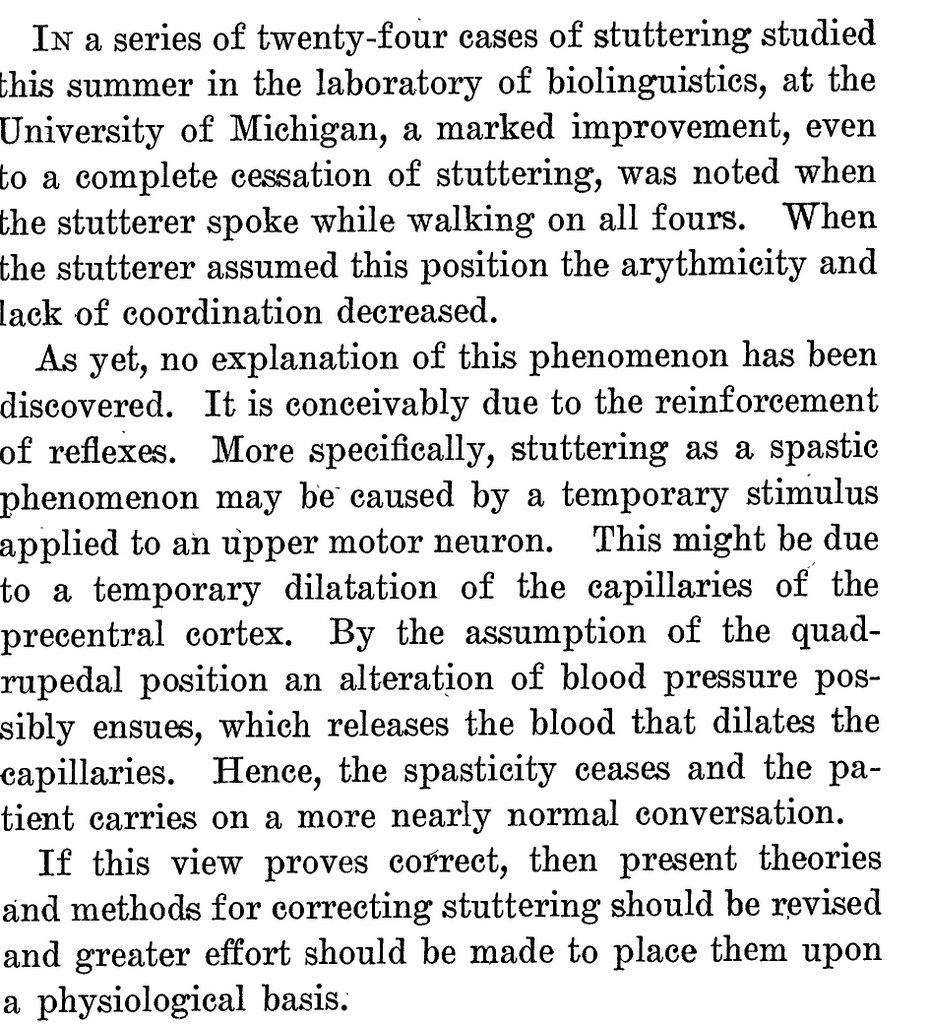
(Credit goes to Oren's labmate Jay Bohland (http://cns.bu.edu/~jbohland). The article was published in 1935: Science, New Series, Vol. 82, No. 2135 (Nov. 29, 1935), p.518 )
Monday, April 24, 2006
Web experiments
Sorry, I am not posting a lot currently... I am out of ideas.
But, yesterday, I had an interesting idea! One of the biggest problems for researchers (in general and in stuttering) is to get enough people to participate in their experiments. Typically, you need between 10 and 20 people, and often one control group and one stuttering group. This is not easy, and you need to advertise your experiment, get 20-30 people to agree to participate, schedule 20-30 meetings, and do 20-30 experiment.
Why can you not do the experiments via the web? You can reach many more people, and 20-30 will always participate. The easiest experiments are questionaires: just create a webpage with a form structure and a database behind. This is a standard technique. But you can also do more sophisticated experiments. For example, the experimental subject uses a software where he needs to press some button or react to a visual stimuli. Such software can be written in Java, and using Java Web Start they run on your computer via your webbrowser.
But as with all interesting ideas, the idea is 5%, and 95% is implementation... :-)
But, yesterday, I had an interesting idea! One of the biggest problems for researchers (in general and in stuttering) is to get enough people to participate in their experiments. Typically, you need between 10 and 20 people, and often one control group and one stuttering group. This is not easy, and you need to advertise your experiment, get 20-30 people to agree to participate, schedule 20-30 meetings, and do 20-30 experiment.
Why can you not do the experiments via the web? You can reach many more people, and 20-30 will always participate. The easiest experiments are questionaires: just create a webpage with a form structure and a database behind. This is a standard technique. But you can also do more sophisticated experiments. For example, the experimental subject uses a software where he needs to press some button or react to a visual stimuli. Such software can be written in Java, and using Java Web Start they run on your computer via your webbrowser.
But as with all interesting ideas, the idea is 5%, and 95% is implementation... :-)
Wednesday, April 19, 2006
Make a donation
You have probably noticed that I have installed a donation button.
I spend a lot of time and money researching and attending conferences as a self-financed researcher. There might be a few of you who want and have the means to support me. I am testing whether this could be a means of getting money. Any donation would go towards my new project. I want to create a website dedicated to stuttering research.
If you want to invest serious money in advancing stuttering research, please contact me under tom.weidig "@" physics.org! I'll be happy to advise.
P.S. Let's hope a few Sultans stutter or their kid stutter AND read my blog! There must be some who stutter! :-)
I spend a lot of time and money researching and attending conferences as a self-financed researcher. There might be a few of you who want and have the means to support me. I am testing whether this could be a means of getting money. Any donation would go towards my new project. I want to create a website dedicated to stuttering research.
If you want to invest serious money in advancing stuttering research, please contact me under tom.weidig "@" physics.org! I'll be happy to advise.
P.S. Let's hope a few Sultans stutter or their kid stutter AND read my blog! There must be some who stutter! :-)
Monday, April 17, 2006
Carl explained?
So here is my possible interpretation of Carl's introspection: see last post, too.
1) What you describe, sounds like a transition from one system to another. You go from your old car, which is very slow, to your new car, at first, you are slower driving your new car as you need to get used to the new car. Or you fire a bad employee, and hire a good one, but it needs time for the good one to become more effective. Thus, the phenomena of it getting worse before getting better is a very very general phenomena.
2) The same phenomena will happen if you switch to singing, chorus reading, reading, voluntary stuttering, acting, speaking loud and so on: see what Per thinks here. You switch your focus to how you say things.
To summarise, you start out the day without thinking about how to speak, you focus on the message, you notice that you stutter, you switch to a different mode, this causes you initial problems, then you are fully tuned into the mode, and you are more fluent.
To summarise, what Carl describes are very general phenomena happening in many different non-stuttering situations. Though they are not very important from a science point of view. But the most important insight is to ask why he becomes more fluent in this new mode. And here there is one theory, revived by Per Alm, that we have two system: one unstable automatic speech and one normal for active-control-over-how-we-say-it speech.
...I've often noticed (through introspection) that when my mind races and I have a hard time focusing, I stutter;When we are in a more emotional state, we have less control over our motor and cognitive functions. And we are more slaves of our emotions, which was very important for our survival thousands of years ago. Also, you are more likely to have a racing mind when you have a bad day. Even "normal" people stutter when under extreme stress or emotions, but we just have a very low threshold.
when I force myself to say one-word-after-another, cancelling all blocks with great deliberation, I seemingly stutter more badly for the first seconds, and then, if I allow my mind to slow down and go into synch with my speech, I'm completely fluent.I have similar experiences.
1) What you describe, sounds like a transition from one system to another. You go from your old car, which is very slow, to your new car, at first, you are slower driving your new car as you need to get used to the new car. Or you fire a bad employee, and hire a good one, but it needs time for the good one to become more effective. Thus, the phenomena of it getting worse before getting better is a very very general phenomena.
2) The same phenomena will happen if you switch to singing, chorus reading, reading, voluntary stuttering, acting, speaking loud and so on: see what Per thinks here. You switch your focus to how you say things.
To summarise, you start out the day without thinking about how to speak, you focus on the message, you notice that you stutter, you switch to a different mode, this causes you initial problems, then you are fully tuned into the mode, and you are more fluent.
This is all at a very slow pace. If I continue with that, resisting my extremely strong urges to lose focus on a single thought-process, and see each word in my mind before I say it, it becomes easier within a few minutes, and I can speed up just a bit. If I continue this with various strangers throughout the day (also using breathing techniques), I'm almost completely fluent by the end of the day.The more you are tuned into the mode, the easier it becomes. And also, you are less concerned by your speech, and you become more relaxed which also makes it easier.
The urge of the mind to skip back into its default, unfocused, stuttering "track" remains, but will presumably lessen or go away with time.This is also a very general phenomena. Take eating chocolate or starting jogging. At first, it is hard, and then it become easier. But there is still an urge to go back, and eventually you succumb to it slowly but surely.
To summarise, what Carl describes are very general phenomena happening in many different non-stuttering situations. Though they are not very important from a science point of view. But the most important insight is to ask why he becomes more fluent in this new mode. And here there is one theory, revived by Per Alm, that we have two system: one unstable automatic speech and one normal for active-control-over-how-we-say-it speech.
Saturday, April 15, 2006
Can introspection help?
Carl Joakim Gagnon has posted the following question:
Here are my views on the use of introspection or first-person reports.
1) There is no conflict whatsoever between a first-person experience (introspection) and a third-person science.
2) A first-person report is never wrong as long as the report only contains experiences. For example, no-one can tell you that your statement "I like Tom's blog", "I am not scared when I stutter", or "I like pink" is wrong.
3) Can you use such first-person reports in helping to advance third-person science? I always listen to first-person reports as they may offer food for thought and inspiration to look for new avenues. However, I am playing with the devil because even if you are a professionally trained thinker / scientist you will almost inevitably commit logical fallacies when trying to generalise the first-person report or your experience to a population.
4) To summarise, introspection of my own experience or a first-person reports can be a useful inspiration to construct theories, but they need to be tested with the scientific method.
5) Here are some of the pitfalls that I constantly encounter:
a. You cannot know whether an effect is present in all stutterers or only specific to the person who gives the first-person report. You can only find that out by doing a statistical analysis.
b. Reports might use the same words, but they might be different meaning. The words are very loosely defined. Your fear of a threat is not my fear of embarrassment. Your block is my slight hesitation.
c. Memories gets re-written every time they are re-called, and many memories are a mixture of a seed of true memory, and post-hoc interpretation.
d. Virtually always the reports are not actually reports of immediate experiences but a coherent story that your mind has woven from experiences and interpretation of what the gaps could be. The readers of first-person reports finds the untangling very difficult and tricky.
e. The greatest pitfall I see with introspection is the logical fallacy "Correlation is not necessarily causation". For example, "I started stuttering when my brother was born, and hated not being the focus of attention anymore" are factually correct, but for many this sounds like great evidence for a conflict between siblings being the cause of my stuttering". But I could also have written "I started stuttering [at age 3 at the age everyone starts stuttering]", "my brother was born [when I was age three which is not very surprising as parents have children at a 2-3 year interval], and "I hated not being the focus of attention anymore [like millions of other kids]". Now suddenly correlation between the three statements sounds like a coincidence and not like a casual link between them.
So to summarise, I use introspection or first-person reports for inspiration, but you are playing with the fire. And almost everyone that uses them gets burned. But luckily for them they don't notice the burns. :-)
Note: Some scientists refuse the use of introspection and first-person experiences as "impure science", but they are wrong. Playing with the fire can be highly insightful, if you are careful.
I'd like a post on how you see the general relation between neuroscience and that oldest guide to how the mind works, introspection. Surely the only way to even design and understand experiments is coming at them from both angles?
...I've often noticed (through introspection) that when my mind races and I have a hard time focusing, I stutter; when I force myself to say one-word-after-another, cancelling all blocks with great deliberation, I seemingly stutter more badly for the first seconds, and then, if I allow my mind to slow down and go into synch with my speech, I'm completely fluent. This is all at a very slow pace. If I continue with that, resisting my extremely strong urges to lose focus on a single thought-process, and see each word in my mind before I say it, it becomes easier within a few minutes, and I can speed up just a bit. If I continue this with various strangers throughout the day (also using breathing techniques), I'm almost completely fluent by the end of the day. The urge of the mind to skip back into its default, unfocused, stuttering "track" remains, but will presumably lesson or go away with time.
So that's the introspection side of things. Any way to relate that first-hand report to neuroscience (to approach the problem from the other angle)?
Here are my views on the use of introspection or first-person reports.
1) There is no conflict whatsoever between a first-person experience (introspection) and a third-person science.
2) A first-person report is never wrong as long as the report only contains experiences. For example, no-one can tell you that your statement "I like Tom's blog", "I am not scared when I stutter", or "I like pink" is wrong.
3) Can you use such first-person reports in helping to advance third-person science? I always listen to first-person reports as they may offer food for thought and inspiration to look for new avenues. However, I am playing with the devil because even if you are a professionally trained thinker / scientist you will almost inevitably commit logical fallacies when trying to generalise the first-person report or your experience to a population.
4) To summarise, introspection of my own experience or a first-person reports can be a useful inspiration to construct theories, but they need to be tested with the scientific method.
5) Here are some of the pitfalls that I constantly encounter:
a. You cannot know whether an effect is present in all stutterers or only specific to the person who gives the first-person report. You can only find that out by doing a statistical analysis.
b. Reports might use the same words, but they might be different meaning. The words are very loosely defined. Your fear of a threat is not my fear of embarrassment. Your block is my slight hesitation.
c. Memories gets re-written every time they are re-called, and many memories are a mixture of a seed of true memory, and post-hoc interpretation.
d. Virtually always the reports are not actually reports of immediate experiences but a coherent story that your mind has woven from experiences and interpretation of what the gaps could be. The readers of first-person reports finds the untangling very difficult and tricky.
e. The greatest pitfall I see with introspection is the logical fallacy "Correlation is not necessarily causation". For example, "I started stuttering when my brother was born, and hated not being the focus of attention anymore" are factually correct, but for many this sounds like great evidence for a conflict between siblings being the cause of my stuttering". But I could also have written "I started stuttering [at age 3 at the age everyone starts stuttering]", "my brother was born [when I was age three which is not very surprising as parents have children at a 2-3 year interval], and "I hated not being the focus of attention anymore [like millions of other kids]". Now suddenly correlation between the three statements sounds like a coincidence and not like a casual link between them.
So to summarise, I use introspection or first-person reports for inspiration, but you are playing with the fire. And almost everyone that uses them gets burned. But luckily for them they don't notice the burns. :-)
Note: Some scientists refuse the use of introspection and first-person experiences as "impure science", but they are wrong. Playing with the fire can be highly insightful, if you are careful.
Friday, April 14, 2006
List of unsolved issues
I am currently editing a debate between Scott Yaruss and Mark Onslow. I want to share with you some of the questions that they have raised and are still unanswered by research.
Mark asked the following questions:
Scott Yaruss has given an even longer list of questions with references. (Please note that especially the references are "from the top of his head")
Mark asked the following questions:
Why do repeated movements predominate at the onset of stuttering?
Why can stuttering be intractable for a lifetime?
Why do those who stutter have problems with tapping finger sequences?
Why do those who stutter have the problem while playing wind instruments?
Scott Yaruss has given an even longer list of questions with references. (Please note that especially the references are "from the top of his head")
Why does stuttering behavior start in children at a time of rapid expansion in linguistic, motoric, and temperamental aspects of their development (see the work of Conture, Yairi, and many others)?
Why do people who stutter react to stuttering in the way they do (see the work of Cooper, Manning, Murphy, Quesal, Sheehan, Williams, and others)?
Why does the occurrence of stuttering behavior seem to be so closely linked with aspects of language planning in both young children and adults (see the work of Bernstein Ratner, Conture, Hall, Howell, Logan, and others)?
More specifically, why are the loci of stuttering moments not distributed randomly with respect to linguistic, situational, and experiential variables (too many references to list)
What is the meaning, in particular, of the apparent linguistic associations in the loci of stuttering?
Why do people who stutter show differences in motoric stability (Smith) and linguistic processing, even when they are not engaged in speaking tasks (Weber-Fox) and why do these factors appear to interact?
Why do people who stutter show differences in neural functioning and possibly even structure (Blomgren, DeNil, Foundas, Fox, Ingham, Maguire, Riley, Watson, and others)?
What is the meaning of the temperamental differences between children who stutter and children who do not stutter that have recently been highlighted (Conture, Oyler, others)?
What of the fact that multiple loci seem to be implicated in genetic modeling of stuttering (Ambrose, Cox, Drayna, Felsenfeld, Yairi, and more)?
Wednesday, April 12, 2006
Covert working
Sorry, I have not been posting a lot over the last weeks. But, strangely enough my visitor numbers kept high. I have been busy working on my flat that I bought in Luxembourg-City. If you ever are close to Luxembourg, let me know and you are invited to stay at my place, but only if you are a stutterer, researcher, or (female) therapist! :-)
But I have also been busy working secretly in the background on stuttering research.
First, I am organsing a research plenary with talks and discussion forum at this year's British Stammering Association (BSA) conference in Telford. I was able to get leading researchers of different areas coming to Telford. I'll tell you more about this exciting event once the details are sorted out.
Second, I have been editing the debate between Scott Yaruss and Mark Onslow on therapy approaches to childhood stuttering. The debate will appear in Speaking Out, the BSA magazine. The editing took hours, but now I understand the arguments put forward much better! I'll probably post the debate on my blog piece-wise if the BSA editor gives his OK.
And finally, I am working on my presentation and proceeding contribution for IFA 2006 in Dublin. Here is the abstract I sent in
But really it's a bit of nonsense to ask for an abstract months before the conference. I will only loosely stick to the abstract. Most researchers are writing the abstract before they write the presentation and paper!
But I have also been busy working secretly in the background on stuttering research.
First, I am organsing a research plenary with talks and discussion forum at this year's British Stammering Association (BSA) conference in Telford. I was able to get leading researchers of different areas coming to Telford. I'll tell you more about this exciting event once the details are sorted out.
Second, I have been editing the debate between Scott Yaruss and Mark Onslow on therapy approaches to childhood stuttering. The debate will appear in Speaking Out, the BSA magazine. The editing took hours, but now I understand the arguments put forward much better! I'll probably post the debate on my blog piece-wise if the BSA editor gives his OK.
And finally, I am working on my presentation and proceeding contribution for IFA 2006 in Dublin. Here is the abstract I sent in
ABSTRACT:
I discuss how best to do the statistical analysis of the outcome data of early childhood intervention. The natural recovery rate of dysfluent children significantly complicates the statistical study of the outcome data. I argue that the standard random control trial setup needs to be modified, because children are randomly assigned to the treatment or control group and by chance one group will have a higher natural recovery rate. I also point out other conceptual difficulties when using a randomized control trial setup. Finally, I suggest that there is no need for a control group, also because other studies have already determined the natural recovery rate.
But really it's a bit of nonsense to ask for an abstract months before the conference. I will only loosely stick to the abstract. Most researchers are writing the abstract before they write the presentation and paper!
Subscribe to:
Posts (Atom)